Command and Staff Officers of the Third Marine Regiment, Bougainville Campaign,
November to December 1943
January 2021
by Daniel M. Popek (Army Brat and Author; Grandson of a Third Marine Regiment [3/3] Veteran, Bougainville Campaign)
Dedication
This Web Page is dedicated to the Officers and Marines (and their living Descendants and Relatives) of the Third Marine Regiment who served in the
Bougainville Campaign in World War 2. My Grandfather was there with Third Battalion, Third Marines.
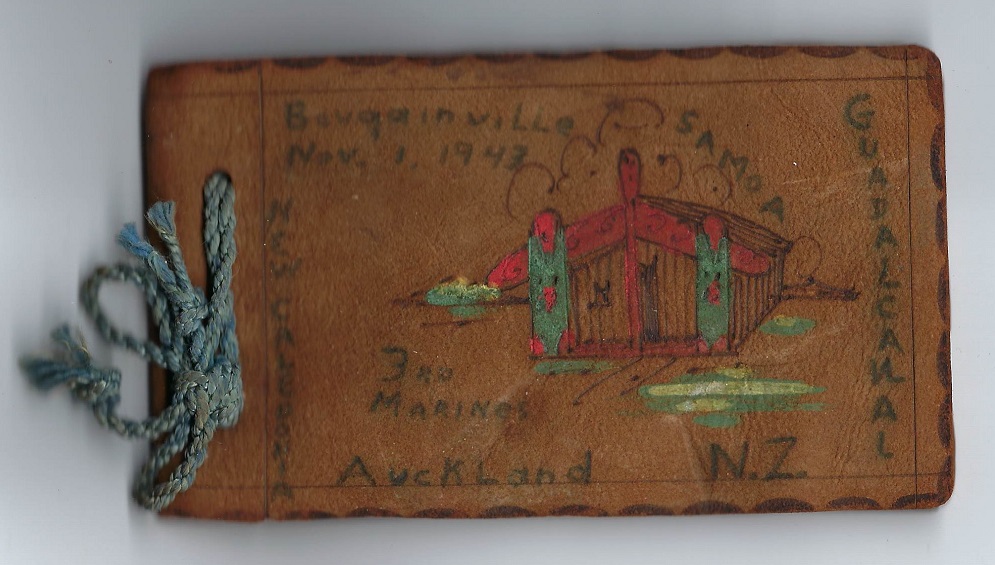
An original, hand-made Autograph Book of an unknown Marine of the Third Marine Regiment who was
medically evacuated from Bougainville. Inside are the signatures of primarily Naval Corpsmen of
a U.S. Navy Hospital Ship and one known Marine Raider Veteran of Bougainville who was also medically
evacuated from Bougainville. The hut shown is likely from American Samoa [Daniel M. Popek Collection].
History Introduction
As the United States Marine Corps drastically expanded to counter the conquering Japanese forces in the Pacific Ocean during World War II, fresh
Marine Regiments were created around a cadre of experienced regular Marine Officers and NCOs. Most of the inexperienced Marines to these regiments
were from the United States Marine Corps Reserve, including some newly commissioned Officers.
The First Marine Division successfully invaded and held the island of Guadalcanal in the Solomon Island chain from August 1942 to spring 1943.
As U.S. Army units arrived in the area, the Allies began offensive operations up the Solomons, attacking some Japanese garrisons and bypassing
others. The Americans gradually developed air superiority in the area by conducting a ruthless air campaign against Japanese air bases including
the large base at Rabaul.
The Third Marine Regiment was reorganized at New River, North Carolina under the command of Colonel Oscar Ray Cauldwell, USMC [1892 - 1959] on
June 16, 1942. The regiment travelled to the West Coast before embarking on a ship and sailing for American Samoa on September 1, 1942. The Third
Marine Regiment joined the Second Marine Brigade on American Samoa on September 15, 1942. A Marine Corps Jungle Fighting School was established on
American Samoa and led by Major Sidney Sanders McMath, USMCR, R-3 [Operations] of the Third Marine Regiment. Marine veterans from the Guadalcanal
campaign served as instructors for the School. Training included weapons, patrolling, scouting, camping and hygiene, fire team maneuvering, compass
and navigation, company and battalion maneuvering and "problems" at all hours of the day. There were specialty schools as well depending on individual
Marine's MOS and duty in their parent unit. Corporal John Carey Jr. [1924 - 2013], an infantry intelligence scout with HQ Co./2/3, gave a great
description of the American Samoa Jungle Fighting School in his book "A Marine from Boston," a recommended read.
Colonel Cauldwell assumed command of the Second Marine Brigade in April 1943 while still leading the Third Marine Regiment. From May 1 to May 9,
1943, the Third Marine Regiment conducted amphibious landing exercises on Upolu Island, Western (British) Samoa. Most of the Third Regiment sailed
from American Samoa on May 23, 1943 for Auckland, New Zealand, where they arrived on May 29, 1943. More training commenced on New Zealand in a
much cooler enviroment for two months. The majority of the Third Marine Regiment sailed from New Zealand for Guadalcanal, stopping at Noumea,
New Caledonia on July 28, 1943. The Third Regiment arrived at Guadalcanal on August 1, 1943. They set up a camp in the "Coconut Grove," and
were subject to some Japanese air bombings. The Third Marine Division was finally assembled at Guadalcanal and included the 9th Marine Regiment,
the 21st Marine Regiment, the 12th Marine Regiment (Artillery), and the 19th Marine Regiment (Engineers). Training for the men of the Third
Regiment continued including patrols towards the mountains where a few scattered Japanese were slowly starving in the jungles. Marine scouts in
particular would practice their tradecraft, sometimes with Guadalcanal native and legend Jacob Vouza, by sneaking up and observing these Japanese
remnant groups at their jungle camps. Marine infantrymen were rounded up on occasion to unload ammunition and supplies from newly arrived ships
at the wharf at Guadalcanal.
Colonel Oscar Cauldwell accepted a Brigadier General commission on September 6, 1943. He became the Third Marine Division XO on September 15, 1943.
Colonel George Wilbure McHenry assumed command of the Third Marine Regiment on September 15, 1943. Training continued on Guadalcanal through September
and early October 1943. The Third Marine Division loaded their equipment and supplies and left Guadalcanal on October 13, 1943. The Marines conducted
another landing exercise on Efate Island, New Hebrides, a few hundred miles southeast of Guadalcanal, from October 17 through 20, 1943. The Third
Marines reembarked on October 20, 1943 to head northwest for enemy-held Bougainville.
Very early on the morning of November 1, 1943, Navy Task Force 31 dropped anchor in Empress Augusta Bay on the western shore of Bougainville Island
in the formerly British Solomon Islands. Operation Cherry Blossom was planned to seize a significant piece of Japanese-held territory in the middle
of the western shore of Bougainville. American Military Intelligence knew that most of the estimated 45,000 to 65,000 Japanese forces on the island
were on the north and south ends of the island. On the east coast, a nice road was available to quickly move Japanese troops around. The west coast
was mostly undeveloped. American military planners decided that the U.S. Third Marine Division would land two of its regiments with support units
using amphibious landing craft to seize and expand a perimeter on the western shore. Ultimately, three airstrips were to be constructed for Americans
to gain air superiority in the area, particularly against the large Japanese base at Rabaul. The Japanese soldiers and sailors on Bougainville would
be isolated and allowed to "wither on the vine." A secondary operation against the Treasury Islands south of Bougainville would be conducted by the
Eighth New Zealand Brigade [New Zealand Third Division] to eliminate a battalion-sized Japanese garrison there and to set up an airstrip and an
Allied radar station.
American destroyers supporting the amphibious operation against Bougainville opened fire with their five-inch guns against presumed targets on the
shore at first light on November 1. The Third and Ninth Marine Regiments, supported by the Third Marine Defense Battalion (Lt. Col. Edward
H. Forney), the Second Marine Raider Battalion (Lt. Col. Joseph P. McCaffery), the Third Marine Raider Battalion (Lt. Col. Fred D. Beans), and a
couple of Naval Construction Battalions all landed under enemy fire. The Third Marine Regiment disembarked to the right from Cape Torokina northwest to
the Koromokina River. The Ninth Marine Regiment under Colonel Edward A. Craig landed to the left from the Koromokina River northwest to the
Koromokina Lagoon. First Battalion, Third Marines (1/3) landed right into a bunker complex at Torokina Point defended by a Japanese battalion and
saw heavy fighting most of November 1. Second Battalion, Third Marines (2/3) and Third Battalion, Third Marines (3/3) landed and moved inland into
dense swamps. The Second Raider Battalion landed on Parauta Island and saw heavy fighting clearing out entrenched enemy forces and snipers on the island.
Additional Marine units landed after the shoreline was secured including the 12th Marines (Artillery) and the 19th Marines (Engineers) of the Third
Marine Division. The Japanese landed a provisional battalion from Rabaul to the left of the Ninth Marines at dawn on November 7, 1943. This Japanese
battalion was isolated and virtually destroyed by accurate artillery fire from the 12th Marines and a counterattack by 1/3 through 1/9's lines.
As November continued, the U.S. Army 37th Infantry (Buckeye) Division landed along with the 21st Marines who both helped expand the American perimeter
on Bougainville. Subsequent battles in the Marine sector included the November 8 to 9 Battle of Piva Trail (primarily 2nd and 3rd Marine Raider Battalions)
and the November 13 to 14 Battle of the Coconut Grove (primarily the 21st Marines). The week long Battle of Piva Forks from November 18 to 25, 1943
featured heavy fighting for 2/3 and 3/3 which I will detail on another planned webpage on the Marines of 3/3.
The Third Marines were replaced on the line by the Ninth Marines reinforced by the 21st Marines, while the Third Marine Regiment was shifted to the
right flank of the American perimeter to rest and refit. On Christmas Day 1943, the Third Marine Regiment embarked on transport ships leaving the
next day for Guadalcanal, which was reached on December 27. The regiment returned to the Coconut Grove encampment on Guadalcanal. Several Marines,
including my Grandfather, were diagnosed with filariasis, a mosquito-born tropical disease, and were soon evacuated to the United States. New replacement
Marines would join the Third Marine Regiment to refit and train for their next campaign in July 1944, which would be at Guam.
The main purpose of this webpage is to introduce the reader to the original Command and Staff Officers of the Third Marine Regiment in the Bougainville
Campaign. These men had interesting stories in their own right, and they should be remembered. I also hope to inspire other independent Historians to
do some similar microstudies of other Marine Regiments; there are many worthy ones to choose from. Of course, other time periods can be researched as
well, from World War 2, Vietnam, to the modern wars in the Middle East. Take some Initiative, Independent Historians, and make it happen! (because
leftist Academic Historians will never get it done ...)
Military Organization of the Third Marine Regiment at Bougainville, November to December 1943
Headquarters and Service Company, Third Marines (Colonel George W. McHenry, USMC / Colonel Walter A. Wachtler, USMC)
Weapons Company, Third Marines (Major Richard I. Moss, USMC)
First Battalion, Third Marines (Major Leonard M. Mason, USMC [WIA] / Major Charles J. Bailey Jr., USMC)
Second Battalion, Third Marines (Lt. Colonel [Jose] Hector de Zayas Jr., USMC; Later killed at the Battle of Guam in July 1944)
Third Battalion, Third Marines (Lt. Colonel Ralph M. King, USMCR)
Photo of the Command and Staff Officers of the Third Marine Regiment in December 1943
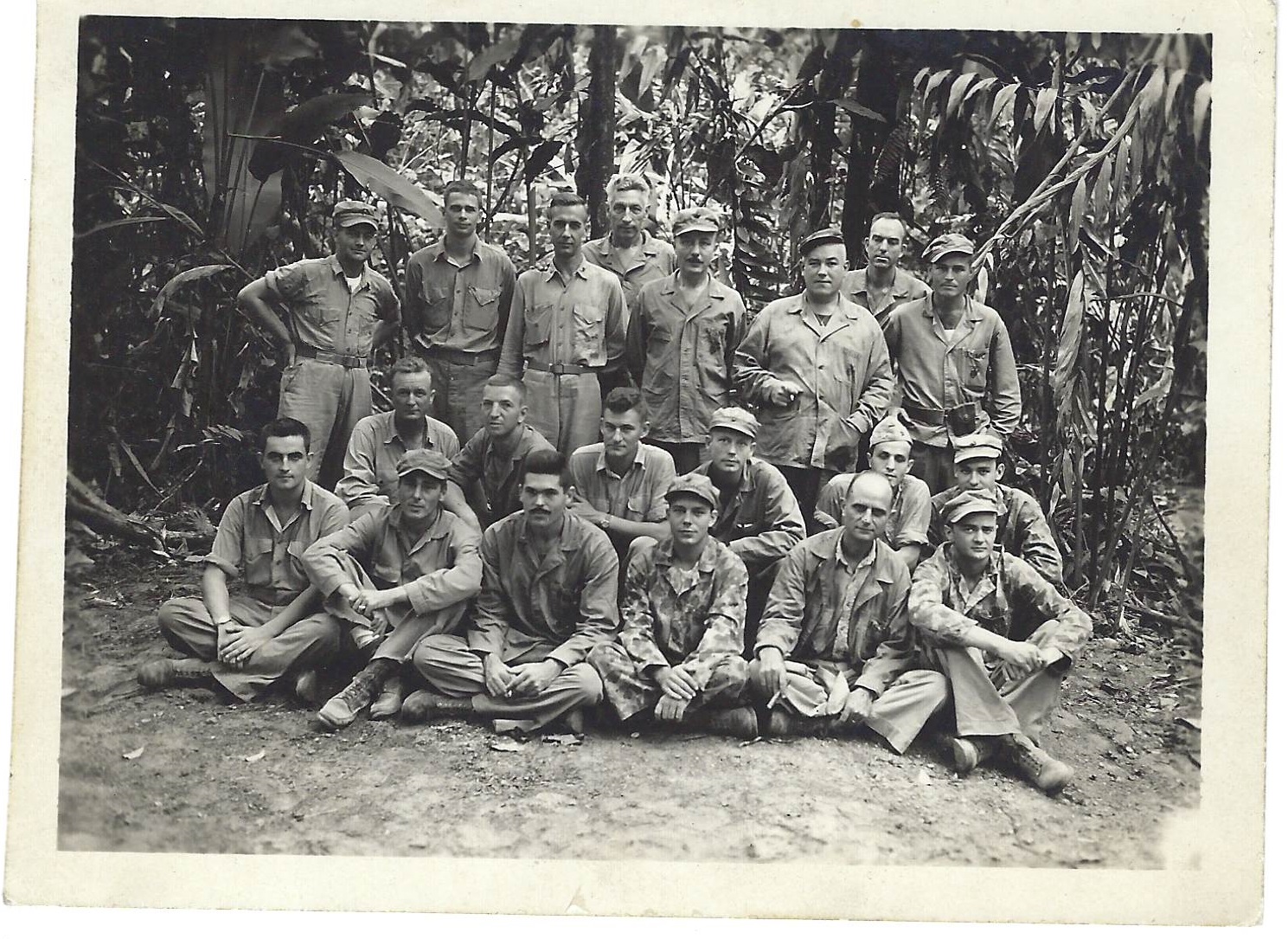
Front Row, Sitting, Left to Right:
Captain Frank J. Clarke, USMC, Asst. R-4; Captain John Cherry Monks Jr., USMCR, Asst. R-3; Major Henry Aplington II, USMC, Regt. Artillery
Liaison Officer; Major Robert C. Walker, USMCR, Regt. Communications Officer; Captain John W. Winford, USMCR, Regt. Gas and Ordnance Officer;
Warrant Officer [Marine Gunner] William F. Pollak, USMC, Asst. Regt. QuarterMaster
Second Row, Kneeling, Left to Right:
Warrant Officer [Marine Gunner] James H. Greer, USMC, Asst. Regt. Munitions Officer; Major Grant Crane, Ph.D., USMCR, R-4;
Major John E. McDonald, USMCR, Regt. QuarterMaster; First Lieutenant Claude O. Neugent, USMCR, Asst. R-2;
Lieutenant Chauncey K. McGeorge, M.D., USNR, Asst. Regt. Surgeon; Captain Harry W. Edwards, USMC, Asst. R-3
Third Row, Standing, Left to Right:
Lieutenant (J.G.) George M. Kempker, USNR, Regt. Chaplain (Catholic); First Lieutenant John W. Foley Jr., USMCR, R-2;
Lieutenant Commander Luther I. Fisher, M.D., USNR, Regt. Surgeon; Colonel Walter A. Wachtler, USMC, CO;
Lieutenant Colonel George O. Van Orden, USMC, XO; Major Sidney S. McMath, USMCR, R-3
Fourth Row, Standing, Left to Right:
Major Ervin R. Whitman, USMC, Regt. Police, Recreation, and Morale Officer; Lieutenant Herbert A. Smith, DDS, USNR,
Regt. Dental Officer
Photo likely taken by Sgt. Curtis E. Francis, Intelligence Section, HQ Co., Third Marine Regiment; from Major Grant Crane Collection
[Daniel M. Popek Collection]
Commanding Officers, Third Marine Regiment
Colonel George Wilbure McHenry, USMC [Legion of Merit Medal; Silver Star; Navy Cross - Bougainville Campaign] "Big Mac"

Photo of First Lieutenant George W. McHenry about 1923 from the Washington, D.C.
"Evening Star" Newspaper, September 12, 1937
Born: September 26, 1895 in Dana, Illinois
George enlisted in the Marine Corps in January 1916. He served at the American Legation in Peking, China during World War 1.
He returned to Quantico, Virginia by mid-1918 where he attended Officers Training Camp. He was commissioned a Second Lieutenant
by January 1919. Assigned to the 7th Marine Regiment at Guantanamo Bay, Cuba, George was sent later to Santo Domingo, where he
served with the 4th Marine Regiment. By the end of 1923, Lieutenant McHenry returned to Quantico, Virginia. In 1927, First
Lieutenant McHenry was stationed at San Diego, California. From February 1, 1928 to May 6, 1929, George McHenry commanded
the Headquarters Company, Second Battalion, 11th Marines in Nicaragua. In August 1928, McHenry led a patrol against Nicaraguan
Sandino bandits whom he defeated in two engagements even though being ambushed both times by the bandits. First Lieutenant McHenry
was awarded the Navy Cross and the Nicaraguan Medal of Merit for his service in Nicaragua.
In 1930, Lieutenant McHenry was assigned to San Diego, California before returning to Quantico in 1931. He played football for the
Quantico Marine Base team and he coached and managed various Marine athletic teams on base. On September 9, 1933, George sailed from
Norfolk, Virginia to San Francisco, California on the USS Henderson. First Lieutenant McHenry boarded the USS Chaumont on October 20, 1933
for Woosong, China, where he arrived on November 23, 1933. George assumed command of H Company, Second Battalion, Fourth Marines at
Shanghai, China and later commanded E Company and F Company. On July 2, 1934, George was promoted to Captain in command of F Company/2/4
still in China. He returned to San Diego, California by April 1936, where he was the R-1 (Regimental Adjutant) for HQ Company, 6th Marines.
In spring 1937, Captain McHenry moved to Quantico, Virginia where he served with the Marine Rifle Range Detachment before being
assigned as Inspector-Instructor for the Fifth Marine Reserve Battalion at Washington, D.C. George McHenry was promoted to Major on
June 25, 1938.
The Marine Corps directed Major McHenry to become an Inspector of Navy Material in Dunedin, Florida in 1941. After the Japanese attack on
Pearl Harbor in December 1941, Major George McHenry was promoted to Lieutenant Colonel on January 13, 1942. As regiments for the planned
Third Marine Division were created at New River, North Carolina, Lieutenant Colonel McHenry was assigned as CO to HQ Company, 2nd Battalion,
21st Marines by October 1942. In April 1943, the still-independent 21st Marines were training in New Zealand. George McHenry was promoted to
full Colonel later in 1943 and transferred to Third Marine Division Special Troops. On September 6, 1943, he assumed command of the Third
Marine Regiment on Guadalcanal and served most of the Bougainville Campaign as the CO. Colonel McHenry received a Silver Star for his
leadership in assisting First Battalion, Third Marines after CO Major Leonard Mason was seriously wounded on November 1, 1943. In addition,
Colonel George McHenry was awarded a second Navy Cross for his leadership of the Third Marine Regiment during the week-long Piva Forks action
on Bougainville. Colonel McHenry was evacuated for sickness (most likely for filariasis or malaria) on December 17, 1943 and sent back to
the United States. He was Chief of Staff of the Marine Training Command at Camp Lejeune, North Carolina in 1945. Soon after the war ended,
he retired as a Brigadier General and moved to Miami, Florida.
George McHenry married Ethel E. Snyder [1896 - 1978] of the York, Pennsylvania area before 1920. He had two children. His son, George W. Jr.,
[1920 - 2004] served active duty in the Marine Corps as an officer reaching the rank of Colonel. General McHenry died of cancer at Key West,
Florida on March 15, 1956.
Burial: Arlington National Cemetery
Colonel Walter Aloysius Wachtler, USMC "Dutch"
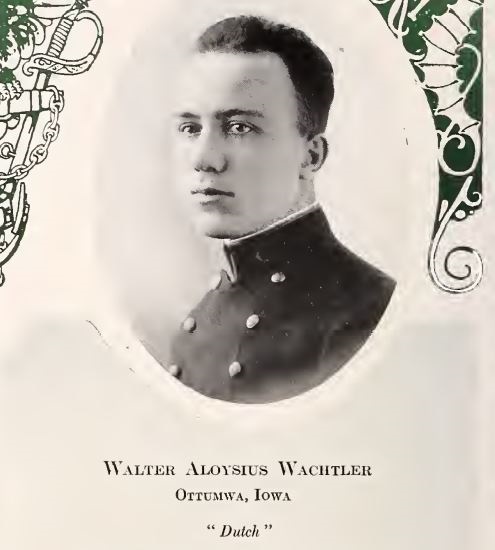
Photo of Midshipman Walter A. Wachtler from 1920 Lucky Bag USNA Yearbook.
Born: November 26, 1896 in Ottumwa, Iowa
Education: Ottumwa High School, Ottumwa, Iowa, 1915
U.S. Naval Academy, Class of 1920
After commissioning as a Second Lieutenant in the Marine Corps, Walter served with the 15th Marine Regiment and later the
Fourth Marines in the Dominican Republic through mid-1922. Lieutenant Wachtler subsequently worked at the Philadelphia
Navy Yard, where he was promoted to First Lieutenant in February 1925. Additional Marine assignments in the 1920s took
Lieutenant Wachtler to Marine Headquarters in Washington, D.C. and the American Legation in Peking, China. The 1930s
saw him in Philadelphia, Quantico, and later on the USS Chester in California where he was promoted to Captain in
November 1934. Captain Wachtler served with a few different Naval ship Marine detachments before he returned to Quantico
in late 1936. He was transferred to Marine Headquarters in Washington, D.C. in 1938, when he was promoted to Major in
November. After the Pearl Harbor attack, Major Wachtler was promoted to Lieutenant Colonel at Marine Headquarters in
January 1942. On October 6, 1942, Walter Wachtler was made the D-1 (Adjutant) for the Third Marine Division at Camp
Elliott near San Diego, California. In 1943, he was an Assistant Chief of Staff for the Division and commanded the
Special Troops Battalion. Wachtler was promoted to full Colonel in October 1943 right before the start of the
Bougainville Campaign.
Colonel Wachtler commanded the Third Marine Regiment only a short time, from December 17 to December 27, 1943 (see
photo above). On December 28, 1943, Walter Wachtler was made the C-3 [Corps Operations Officer] for the 1st Marine
Amphibious Corps and later the 3rd Marine Amphibious Corps in the Guam Campaign. He was awarded the Legion of Merit
award for his service in the Guam Campaign. After World War 2 ended, Colonel Wachtler became the Chief of Staff at
Camp Lejeune, North Carolina. He was promoted to Brigadier General before his retirement in 1947.
Walter married Leila Cottrell of Virginia in 1921. General Wachtler died of a heart attack at his home in
Washington, D.C. on October 4, 1972.
Burial: Arlington National Cemetery
Lieutenant Colonel George Owen Van Orden, USMC Executive Officer, Third Marine Regiment [Navy Cross; Legion of Merit - Bougainville Campaign] "The Beast"
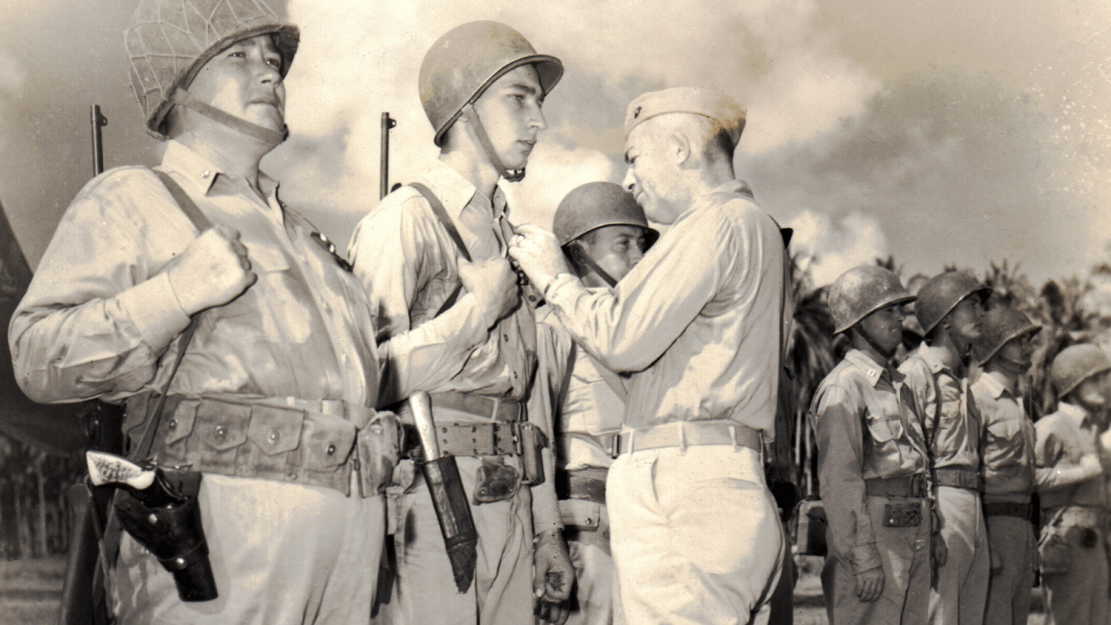
Lieutenant Colonel George Van Orden receives the Navy Cross on Bougainville from Major General
Allen Turnage with other Marines from the Third Marine Division. Note the ivory-handled revolver.
USMC Photo.
Born: September 9, 1906 in Pensacola, Florida
Education: St. John's [Northwestern] Military Academy, Delafield, Wisconsin
Attended the U.S. Naval Academy for two years [did not graduate]
George was a Marine Brat whose father George Van Orden [1878 - 1957] was a career active duty Marine officer who
achieved the rank of full Colonel. George the younger attended the U.S. Naval Academy for a couple of years before
dropping out and enlisting on May 29, 1925 in the Marine Corps. His first assignment as a Private was at the Marine
Barracks at the U.S. Naval Academy in Annapolis. Corporal George Van Orden served with the 49th Company, 1st Battalion,
Fifth Marines at Guantanamo Bay, Cuba in early 1926. By 1927, George was a Sergeant at Quantico, Virginia and the Navy
Yard at Washington, D.C. Later in 1927, Sergeant Van Orden attended Officer Candidate School at the Marine Barracks in
Washington, D.C. On March 3, 1928, George Van Orden was commissioned as a Second Lieutenant at the Basic School
at the Philadelphia Navy Yard. Lieutenant Van Orden attended the Naval Aviation School at Hampton Roads, Virginia
in November 1928. By May 1929, George was assigned to Headquarters Detachment, Second Battalion, Second Marines in
Haiti. He was quickly detached to try out for the U.S. Marine Corps Rifle and Pistol Team Detachment at Wakefield,
Massachusetts. Already exhibiting good shooting skills as a youth, Lt. Van Orden honed his rifle and pistol skills
by competing in numerous shooting tournaments as a Marine. Lt. Van Orden returned to the Second Marines in Haiti by
early 1930.
Lieutenant Van Orden served at Pensacola Naval Air Station in late 1931 through early 1932. By mid-1932, he had returned to
Quantico then off to the Philadelphia Naval Yard. Lt. Van Orden joined a Marine Detachment on the USS Wyoming in 1934,
then attended the Marine Advanced Base Weapons Class at Quantico by the end of the year. He was commissioned as a First
Lieutenant in December 1934. In 1935, Lt. Van Orden served with marine detachments on the USS Idaho and USS Oklahoma
battleships. George Van Orden was promoted to a Captain on July 28, 1936. After serving at some Marine rifle ranges in
1937, Captain Van Orden was assigned to the Brooklyn Navy Yard briefly in December 1937 before returning to Quantico, Virginia.
The year 1938 saw George commanding the Marine Rifle Range Detachment at Cape May, New Jersey. In the spring of 1939,
Captain Van Orden served detached at the Wakefield, Massachusetts Marine Rifle Range. On September 15, 1939, George
went to the Marine Ordnance Field Service School at the Raritan Arsenal in New Jersey before joining the Marine Rifle
Range Detachment at Quantico on December 20, 1939. Still at Quantico when the Japanese attacked Hawaii in December 1941,
George Van Orden was promoted to Major on January 6, 1942. By September 1, 1942, Major Van Orden was promoted to
Lieutenant Colonel and given command of First Battalion, Third Marine Regiment. The regiment sailed to American
Samoa in September 1942.
Lieutenant Colonel Van Orden continued command of the First Battalion until June 13, 1943, when he became Executive
Officer of the Third Marine Regiment, replacing Lieutenant Colonel James M. Smith, who was transferred to the First
Marine Amphibious Corps. On August 27, 1943, Lt. Col. Van Orden, along with Major Sidney McMath, was detached as an
observer with the 14th U.S. Army Corps, where he "participated in operations against [the] enemy on Vella La Vella,
Solomon Islands with Combat Team 35, U.S. Army. August 31 and September 1, participated in operations against enemy
in Gizo Channel and North of Vella La Vella and Kalembougora with Motor Torpedo Boat 134, based at Rendova" [Third
Marine Regiment Muster Roll, September 1943]. George rejoined the Third Marine Regiment on September 5, 1943. He landed
with the Third Marine Regiment at Cape Torokina, after Major Leonard Mason of 1/3 was wounded. George helped lead the
First Battalion against Japanese bunkers and trenches for which he received the Navy Cross medal and was slightly wounded
by machine gun fire.
George Van Orden assumed command of the Third Marine Regiment on December 28, 1943 after the regiment evacuated Bougainville.
He continued as Regimental CO on Guadalcanal until January 23, 1944 when he was sent to the hospital. He rejoined the Third
Marine Division as the Deputy Chief of Staff (and Division Infantry Training Officer) and served through the Guam Campaign.
Lieutenant Colonel Van Orden left Guam on September 14, 1944 via an airplane stopping at Honolulu before arriving at San Francisco
on September 16, 1944. He then proceeded to his next command, the Klamath Falls (Oregon) Marine Barracks, where he became the CO.
The Klamath Falls Marine Barracks was a recuperating center for Marines who had tropical diseases from the Pacific Theater.
George was promoted to full Colonel by January 1945 while at Klamath Falls, Oregon. Colonel Van Orden was detached to the
Pacific Theater with the Headquarters and Service Battalion, Fifth Service Depot, Guam on July 20, 1945. He served on Guam until
July 1947 when he joined the Marine Barracks at Quantico, Virginia. In 1948, Colonel George Van Orden was assigned to the First
Marine Corps Reserve District at Boston, Massachusetts. However, he was detached frequently for different shooting competitions
and training programs. Colonel George Van Orden retired from the Marine Corps about September 1949 and was promoted to Brigadier
General.
General Van Orden established a gun shop near Quantico, Virginia after he retired. His son George Mason Van Orden [1939 - 2013]
graduated from the Virginia Military Institute with a B.S. in Civil Engineering and was commissioned as an active duty Marine Corps
Officer. George Mason was also a skilled shooter and won several shooting awards. George Owen Van Orden was a Mason, a member of the
National Council of the Boy Scouts of America [which unfortunately has been ruined by various Leftist organizations], a life member
of both the National Rifle Association and the Eastern Small Bore Rifle Association. George Owen Van Orden died on May 13, 1967.
Burial: Arlington National Cemetery
Sources:
USMC Muster Rolls, 1798 - 1958, NARA Microfilms T1118/T977.
Captain Kyle Watts (USMC), "Gunpowder in their Veins: Four Generations of George Van Ordens," Leatherneck Magazine, Volume 97, August 2014,
pp. 22-26.
Newspaper Article, "Son of Petoskey Man Follows his Footsteps in U.S. Marine Corps," Petoskey News-Review (Petoskey, Michigan), January 12, 1942.
Newspaper Article, "Lt. Col. Van Orden Arrives to Command Barracks Here," Herald and News (Klamath Falls, Oregon), October 28, 1944.
Newspaper Article, "Governor Earl Snell views Military Installations; to Speak at C of C Dinner," Herald and News (Klamath Falls, Oregon),
April 30, 1945.
Newspaper Article, "Filariasis Written Off as Major Medical Puzzle in Marine Corps as Barracks Observe 1st Birthday," Herald and News (Klamath Falls,
Oregon), May 29, 1945.
Newspaper Article, "Col. Van Orden to be Transferred," Herald and News (Klamath Falls, Oregon), June 18, 1945.
Newspaper Article, "Guam Marine Officer Director of Marine Corps Reserve Here," The Boston Globe (Boston, Massachusetts), August 31, 1949.
Newspaper Article, "Miss Geipel Bride of Marine Major [George Mason Van Orden]," Echoes-Sentinel (Warren Township, New Jersey), June 8, 1978.
Staff Officers, Third Marine Regiment
R-1 [Regimental Adjutant; Personnel] Second Lieutenant Clyde Travis Brannon, USMC

Photo of Second Lieutenant Clyde T. Brannon from February 4, 1932 Atlanta Constitution Newspaper article.
Born: June 10, 1902 in Georgia
Clyde enlisted in the Marine Corps on July 5, 1922. He served in the Dominican Republic from 1923 to 1924, Guam from 1925 to
1926, and Nicaragua from 1927 to 1928. He graduated from the Marine Aviation School at Great Lakes, Illinois in the 1920s.
Sergeant Brannon was wounded in a skirmish with Sandino Rebels in Nicaragua in February 1932. Sergeant Clyde Brannon served at
Parris Island; Yorktown, Virginia; the Navy Yard, Washington, D.C.; Brooklyn, New York; the USS Manley (DD-74); the USS Babbitt
(DD-128); Panama Canal Zone; Portsmouth, Virginia; and Quantico, Virginia during the 1930s. In 1940, First Sergeant Brannon
served with 2nd Battalion, 5th Marines at Quantico. He continued with 2/5 in 1941 travelling on the USS Harry Lee (APA-10) to
Guantanamo Bay, Puerto Rico, and New River, North Carolina. Clyde was promoted to Sergeant Major of HQ Co./2/5 in January 1942
at New River, North Carolina. Later in May 1942, Sergeant Major Brannon was commissioned as a Marine Gunner and was transferred
to HQ Co./2/3 where he was the BN-1 (Adjutant) and CO of the Headquarters Company at New River. 2/3 travelled to American Samoa
where a Marine Jungle Fighting School was established in the Pacific Theater. By January 1943, Warrant Officer Brannon was made
the R-1 of the Third Marine Regiment on American Samoa. On October 13, 1943, Clyde Brannon was promoted to Second Lieutenant with
HQ Company, Third Marine Regiment at Guadalcanal.
After serving through the Bougainville Campaign as the R-1, Clyde T. Brannon was promoted to First Lieutenant on December 26, 1943.
He was evacuated back to the United States in January 1944, probably for filariasis. In April 1944, he was recuperating at the U.S.
Naval Air Station in Memphis, Tennessee. By July 1944, Lieutenant Brannon served with the Guard Battalion at Camp Lejeune, where he
served until July 1946. In July 1946, Clyde was reverted back to a Sergeant Major in the Marine Corps Reserve. He resigned from the
Marine Corps Reserve in August 1952. Clyde moved to Gainesville, Florida where he worked for the University of Florida Press many
years. Clyde T. Brannon married Caroline Almedia [Alleen] Fowke [1905 - 1996]. Clyde's son Philip Clyde Brannon [1926 - 2012]
was a World War 2 enlisted U.S. Navy veteran, U.S. Naval Academy Graduate, U.S.M.C. Officer, and Korean War veteran. A member of the
Marine Corps League in Alachua County, Florida, Clyde T. Brannon and his wife became expert handwriting analysts and members of the
International Grapho-Analysis Society. Clyde Brannon died on December 5, 1987. A Great-Grandson, Captain Travis Walker Brannon,
USMC [1988 - 2019], was killed tragically piloting a Marine Attack Helicopter during a training accident in Arizona on March 30, 2019.
Burial: Clyde's body was donated for scientific study; a memorial stone is at the Fowke Memorial Cemetery in Allendale County, South
Carolina.
Sources:
USMC Muster Rolls, 1798 - 1958, NARA Microfilms T1118/T977.
Newspaper Article, "Sergeant Brannon, of Marines, visits Mother in Atlanta," The Atlanta Constitution (Atlanta, Georgia), November 5, 1929.
Newspaper Article, "Marine Wounded in Skirmish: U.S. Sergeant Casualty in Engagement in Nicaragua," St. Louis Post-Dispatch (St. Louis,
Missouri), February 3, 1932.
Newspaper Article, "Sandino Rebels wound Atlantan: Marine Lieutenant [honorary Lieutenant in Nicaraguan Guardia National] Clyde T. Brannon
Struck in Face during Skirmishes," The Atlanta Constitution (Atlanta, Georgia), February 4, 1932.
Newspaper Article, "Three Atlantans Promoted," The Atlanta Constitution (Atlanta, Georgia), May 17, 1942.
Newspaper Article by Sgt. Charles P. Evans [USMCR, Combat Correspondent, HQ Co., Third Marine Regiment], "Atlanta Man is Natural Bush
Fighter," The Atlanta Constitution (Atlanta, Georgia), July 25, 1943.
Newspaper Article, "University of Florida Press, 8 Years Old, Grows Rapidly," Tampa Bay Times (St. Petersburg, Florida), January 25, 1953.
Newspaper Article, "Brannon is Leader of Alachua Chapter, Marine Corps League," The Tampa Tribune (Tampa, Florida), November 12, 1953.
Newspaper Article, "IGAS Meet," The Orlando Sentinel (Orlando, Florida), February 1, 1960.
Newspaper Article, "Don't Write Off Graphoanalysis," The Miami Herald (Miami, Florida), October 8, 1969.
Newspaper Article, Obituary Notice, Clyde Travis Brannon, The Tennessean (Nashville, Tennessee), December 8, 1987.
Newspaper Article, Obituary, Philip Clyde Brannon, The Tennessean (Nashville, Tennessee), September 26, 2012.
Online Obituary [Legacy.com], Captain Travis Walker Brannon, USMC, The Tennessean (Nashville, Tennessee), May 11, 2019.
R-2 [Intelligence] First Lieutenant John Warner Foley Jr., USMCR "Jack"

Photo of John Warner Foley Jr. from Dartmouth College 1937 Yearbook.
Born: February 19, 1916 in New York City
Education: Fort Lee High School, Fort Lee, New Jersey
Dartmouth College, History/Political Science, Class of 1937 [Phi Beta Kappa]
Yale College, Master of Arts, International Relations, 1942
John grew up in Englewood, New Jersey, the son of an Electrical Engineer. His mother, Ellen S. McCarthy, earned a Ph.D. in Chemistry
from Cornell University in 1908. After graduating from high school in New Jersey, John studied at Dartmouth College in Hanover,
New Hampshire. While an undergraduate, John enlisted in the U.S. Marine Corps Reserve on June 6, 1935 as a Private. After graduating
from Dartmouth College in 1937, John was commissioned as a Second Lieutenant in the Marine Corps Reserve. He next attended the London
School of Economics under the Henry Elijah Parker Fellowship [Dartmouth College] earning a certificate in International Law, Politics,
and Economics in 1938. John was accepted with a Henry C. Robinson Fellowship [Yale College] to Graduate School in International Relations
at Yale College where he graduated with a Master of Arts in 1942. John had started a Ph.D. program at Yale, but the Marines needed officers,
and John joined the newly formed Third Marine Regiment on active duty at New River, North Carolina in July 1942. Lieutenant Foley was
the Assistant Intelligence Officer for the HQ Company of the Third Marine Regiment. By January 1943, Second Lieutenant Foley was made the
R-2 [Intelligence] Officer for the Third Marine Regiment. John W. Foley Jr. was promoted to First Lieutenant in February 1943; he was
also the official Censor for all mail for the Third Marine Regiment.
After the Bougainville Campaign was over, Lieutenant Foley was promoted to Captain in February 1944. Admiral Halsey gave Captain Foley
an official commendation for his Intelligence work in the Bougainville Campaign. John Foley continued as the Third Marine Regiment R-2
through the Guam Campaign. In January 1945, Captain Foley was sent back to the United States. He joined the Marine Training Command at
Camp Pendleton in southern California where he served much of 1945. In 1946, Captain Foley was returned to reserve status in the
Washington, D.C. area. He served in the Marine Corps Reserve until 1972 reaching the rank of Lieutenant Colonel.
Captain Foley began a career in the U.S. Department of State assisting with the Japanese Peace Treaty. Later he went to countries in
Africa and eventually became Deputy Assistant Secretary of State for African Affairs. Colonel Foley retired from the State Department
in 1976. John Foley married Mary W. Baxter [1914 - 1992] in 1940 at Milton, Massachusetts. The couple had three sons and two daughters.
John settled in Tappahanock, Virginia in the 1980s and died there on August 5, 2008.
Burial: Arlington National Cemetery
Sources:
USMC Muster Rolls, 1798 - 1958, NARA Microfilms T1118/T977.
Newspaper Article, "Mary W. Baxter sets first for Marriage to John W. Foley Jr.," The Record (Hackensack, New Jersey), May 20, 1940.
Newspaper Article, "Capt. Foley cited by Admiral Halsey," The Record (Hackensack, New Jersey), April 21, 1944.
Newspaper Article, "Englewood Marine Captain Commended," The News (Paterson, New Jersey), May 2, 1944.
Online Obituary [Legacy.com], John W. Foley Jr., The Washington Post (Washington, D.C.), August 9, 2008.
Assistant R-2 [Intelligence] First Lieutenant Claude Odes Neugent, USMCR [Silver Star - Bougainville Campaign]
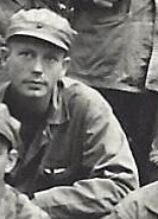
First Lieutenant Claude Neugent from the Third Marine Regiment Staff picture in December 1943.
Photo likely taken by Sgt. Curtis E. Francis, Intelligence Section, HQ Co., Third Marine Regiment;
from Major Grant Crane Collection [Daniel M. Popek Collection].
Born: January 25, 1910 in Cloverport, Kentucky
Education: Unknown
Claude Neugent grew up in the Louisville, Kentucky area. He enlisted active duty in the U.S. Marine Corps on May 3, 1928 when he was
18 years old. He served at Parris Island, South Carolina until his discharge as a PFC in July 1932. By 1940, Claude lived at Great Neck,
New York before World War 2 started. He was working as an accountant for the Federal Reserve Bank in New York City at this time. Claude
enlisted in the Marine Corps Reserve on July 6, 1942, and having three years of active duty Marine Corps service, he was sent directly to
HQ Co., Third Marine Regiment at New River, North Carolina. By October 1942, Claude had been promoted to Corporal and was working in the
Regimental Intelligence Section as a Scout. On February 23, 1943, Claude was commissioned a Second Lieutenant in the Marine Corps Reserve
and was made the Assistant R-2 the next day. During the Bougainville Campaign on December 8, 1943, Claude was promoted to First Lieutenant.
He was awarded the Silver Star award for his reconaissance work in the Cape Torokina area behind Japanese lines and for leading assaults on
Japanese positions on November 1, 1943. Lieutenant Neugent continued in the Staff of the Third Marine Regiment until early 1945. At the
end of World War 2, Claude was transferred to the Marine Corps Reserve. He reached the rank of Major in the Reserve. Claude eventually
moved to Florida and Alabama. He was married a couple of times. Claude Neugent died on September 8, 1998.
Burial: Unknown
Sources:
USMC Muster Rolls, 1798 - 1958, NARA Microfilms T1118/T977.
Newspaper Article, "From Overseas [First Lieutenant Claude Neugent of Great Neck, NY awarded Silver Star]," The Brooklyn Daily Eagle
(Brooklyn, New York), April 2, 1944.
R-3 [Operations] Major Sidney Sanders McMath, USMCR [Silver Star; Legion of Merit - Bougainville Campaign] "The Traveler"

Major Sidney S. McMath detail from the Third Marine Regiment Staff picture in December 1943.
Photo likely taken by Sgt. Curtis E. Francis, Intelligence Section, HQ Co., Third Marine Regiment;
from Major Grant Crane Collection [Daniel M. Popek Collection].
Born: June 14, 1912 in Magnolia, Arkansas
Education: Hot Springs High School, Hot Springs, Arkansas
University of Arkansas, Fayetteville, Arkansas
Sidney was born on a farm in rural Arkansas. He worked on his family's farm, fished, hunted, and rode horses growing up.
The McMath Family moved to Hot Springs, Arkansas in 1922. Sidney attended and graduated Hot Springs High School. He worked
his way through Law School at the University of Arkansas. He completed ROTC at the University of Arkansas and was
commissioned a Second Lieutenant in the regular Marine Corps in August 1936. Lieutenant McMath was sent to the Marine
Barracks at Quantico before attending the Marine Basic School at Philadelphia, Pennsylvania under Captain Lewis "Chesty" Puller.
Sidney resigned his regular commission and accepted a reserve commission as a Second Lieutenant in the Marine Corps in March 1937.
He returned to Hot Springs and married his first wife, Elaine Broughton, before beginning a Law practice in the city. By August 1940,
war with Japan seemed imminent, and Lieutenant McMath rejoined the Marines in Quantico, Virginia. He became an Officer Candidate
instructor and was promoted to First Lieutenant by April 1941. Sidney's first son, Sidney Sandy McMath, was born on August 22, 1941,
while his father was qualifying on a Marine rifle range. After being promoted to Captain in February 1942, Sidney experienced a
personal tragedy when his wife Elaine died of a kidney infection on May 28, 1942 at Quantico.
Following a short period of mourning, Captain McMath was assigned to the Headquarters Company, Third Battalion, Third Marines and became
the Executive Officer of 3/3 by July 1942 at New River, North Carolina. After the Third Marine Regiment travelled to San Diego and
embarked for American Samoa, Sidney McMath was promoted to Major and was given command of the Marine Jungle Training Center of the
Second Marine Brigade. Major McMath with his cadre instructors trained the Marines of the Third Regiment hard in infantry weapons,
patrolling, scouting, unit coordination and communications, and battalion-level tactical problems. Late in the training, the entire
Third Marine Regiment practiced a landing on Apia, Western [British] Samoa. A similar regimental training exercise was conducted on
American Samoa. The Third Marines shipped out to New Zealand arriving there in early June 1943. New Zealand with its cooler climate
was a welcome break for the Marines who had trained on American Samoa. Additional training occurred on New Zealand before the Third
Marine Regiment was sent to Guadalcanal. They camped at the "Coconut Grove" near the coast inside the Marine Corps perimeter on the
"canal." Major McMath was detached in late August 1943 with Lt. Col. George Van Orden as observers with the U.S. Army 43rd Division
on reconnaissance missions in New Georgia. After returning to Guadalcanal, Sidney continued with training before the Third Marine
Regiment embarked on October 13, 1943 for a four day practice landing exercise in the New Hebrides Islands [a.k.a. modern Vanuato Islands,
specifically Mele Bay, Efate Island] to the southeast of Guadalcanal. The Third Marine Division then travelled northwest up to Empress
Augusta Bay on the west coast of Bougainville Island.
After the First Battalion, Third Marines was halted initially by a determined Japanese battalion at Torokina Point, Major Sidney McMath
was sent ashore in a relief wave to assist First Battalion. Cooperating with Lt. Col. George Van Orden and Majors Steve Brody and Chuck
Bailey of 1/3, Sidney led elements of First Battalion against the entrenched Japanese. Later in the day on November 1, 1943, Major McMath
returned to the transport ship USS "President Jackson" in Empress Augusta Bay. Sidney would land again with the Regimental Headquarters
Company and assisted the defeat of the Japanese counter-landing at the Koromokina River from November 7 to 8. Continually expanding their
forward progress, the Third Regiment was stuck in the swamps of Bougainville until November 13 when they finally encountered dry land. As
Regimental Operations Officer, "The Traveler" was busy coordinating the movements of Second and Third Battalions, Third Marines up towards
"Cibik's Ridge," initially discovered by Marine scout John Carey Jr. of 2/3, and captured by Lieutenant Steve Cibik leading a platoon from 2/3.
The brutal Battle of Piva Forks occurred from November 24 to 25, 1943, and Major McMath had to make the difficult decision of denying
artillery support to L Company/3/3 who were pinned down by two Japanese machine gun bunkers. L/3/3 eventually eliminated the enemy bunkers
but lost several of its Marines in the assault. After the Battle of Piva Forks was completed, the Third Marines dug in on their regimental
objective line. They were relieved by the Ninth Marines on November 27, 1943 and marched to a position on the Third Marine Division's
right flank. Major McMath remained with the Third Marine Regiment as it was pulled off the line back towards the beach on December 22, 1943.
Sidney McMath was given a battlefield promotion to Lieutenant Colonel before the Third Marines embarked on Christmas Day for Guadalcanal.
Lt. Colonel McMath was awarded the Silver Star for his work on November 1 and the Legion of Merit for his actions during the Battle of Piva
Forks. Upon arrival at Guadalcanal, many of the Third Marine Regiment officers and men were medically evaluated, and several Marines, including
my Grandfather and Colonel McMath, were medically discharged from the regiment because of filariasis diagnoses. The treatment for mosquito-born
tropical diseases was evacuation to the United States. Sidney McMath joined General Oscar Caldwell's staff at the Marine Training Replacement
Command at Camp Pendleton in California. On September 1, 1944, Colonel McMath was transferred to Marine Corps Headquarters in Washington, D.C.
for Infantry Planning of the coming invasion of Japan. He had met Sarah Anne Phillips on TDY to Washington, D.C. in April 1944, and Sidney
married her on October 6, 1944 at Washington. Fortunately for Sid, he was not required to return overseas for the remainder of the war.
Lt. Col. McMath was transferred to the Marine Corps Reserves in January 1946.
Sidney McMath returned to his law practice in Hot Springs, Arkansas and became a district prosecuting attorney. He successfully ran for
Governor of Arkansas and earned a second term. He led the "GI Revolt" in Arkansas that helped clean up corruption in Arkansas politics.
After losing a third term as governor, Sidney went back to work as a trial attorney and made an unsuccessful run for the U.S. Senate. In July
1951, Sidney was promoted to full Colonel in the Marine Corps Reserve and achieved Brigadier General rank in 1963. General McMath became
a Major General in 1966 and served a couple of weeks in Vietnam on active duty with Marine units, including the Third Marine Regiment.
Two of his sons, Sandy and Phillip, were serving active duty in the Marine Corps at this time. A president of the Third Marine
Division Association, Sidney McMath wrote and published his detailed autobiography, "Promises Kept," with University of Arkansas Press in
2003. Arguably the most famous of the Third Marine Regiment Bougainville veterans, Sidney died on October 4, 2003 at Little Rock, Arkansas.
Burial: Pinecrest Memorial Park, Alexander, Arkansas
Sources:
USMC Muster Rolls, 1798 - 1958, NARA Microfilms T1118/T977.
Major General Sidney S. McMath, "Promises Kept: A Memoir," The University of Arkansas Press (Fayetteville, Arkansas), 2003.
Newspaper Article, "Promoted after Leading Attack," The Times (Shreveport, Louisiana), February 18, 1944.
Newspaper Article, "War Dogs are needed by U.S. Marine Corps," The News-Chronicle (Shippensburg, Pennsylvania), March 30, 1945.
Newspaper Article, "Marine Hero's Wife kills Father-in-Law with Revolver he used on Bougainville," Abilene Reporter-News (Abilene, Texas),
August 9, 1947.
Newspaper Article, "Absolved," Des Moines Tribune (Des Moines, Iowa), August 15, 1947.
Newspaper Article, "Former Governor of Arkansas due for Marine Duty," Honolulu Star-Bulletin (Honolulu, Hawaii), August 22, 1964.
Newspaper Article, "Fulbright Foe," Valley Morning Star (Harlingen, Texas), December 24, 1967.
Newpaper Article, "Marine Vets open Reunion on July 25 [at Gatlinburg, Tennessee]," Asheville Citizen-Times (Asheville, North Carolina),
July 21, 1968.
Newspaper Article, "Former Arkansas Governor Sid McMath dies at age 91," Baxter Bulletin (Mountain Home, Arkansas), October 6, 2003.
The 1948 Arkansas Governor's Race Video:
https://www.youtube.com/watch?v=z51B9cfnZ3Q
Assistant R-3 [Operations] / Liaison Officer Captain John Cherry Monks Jr., USMCR "Johnnie"

Detail of Cadet John Cherry Monks' photo in Virginia Miliary Institute's "The Bomb" Yearbook of 1932.

Cadet John Cherry Monks' photo with his sister Rhoda Monks [1909 - 1987], assistant leaders of
the "Final German" Dance at V.M.I., in V.M.I.'s "The Bomb" Yearbook of 1932.

Cadet John Cherry Monks' profile in V.M.I.'s "The Bomb" Yearbook of 1932.
Born: June 25, 1910 in Brooklyn, New York
Education: Pleasantville High School, Pleasantville, New York ?
Virginia Military Institute (Class Vice-President; Class Valedictorian), Bachelor of Arts, Lexington, Virginia, 1932
John Cherry Monks Jr. was born in Brooklyn, New York, the son of an Immigrant from Levenshulme [suburb of Manchester],
England who worked as an Insurance Adjuster in New York. John and his brother James and sister Rhoda were active in the
local theater at Pleasantville, New York. John matriculated at Virginia Military Institute in 1928, where he joined the
Dramatic Club. While a cadet at V.M.I., John co-wrote a play, "Brother Rat," with cadet Fred F. Finklehoffe, also of
New York. The play became a success on Broadway after John graduated from V.M.I., and it was made into a movie (1938)
starring Ronald Reagan. John became a professional playwright in New York City and Pennsylvania and also worked on film
scripts, including "Brother Rat and a Baby," 1940.
As a V.M.I. graduate, John was direct-commissioned into the Marine Corps Reserve as a First Lieutenant on April 14, 1942.
John joined the General Service Unit, 3rd Marine Corps Reserve District in New York City where he worked as a script writer
for the movie "We are the Marines," which premiered on December 12, 1942 in New York City. By July 1942, Lieutenant Monks
was made the C.O. of Item Co., 3rd Battalion, 3rd Marines at New River, North Carolina, until July 6, 1942, when he became
the X.O. after Captain James R. Ryder Jr. took command of the company. By mid-September 1942, Lieutenant Monks and 3/3
were in American Samoa, and John became a student at the Marine Jungle Fighting School on the island beginning September 26.
On October 23, 1942, John Monks Jr. was transferred to F Co./2/3, before rejoining I Co./3/3 on November 20, 1942 when he was
the acting C.O. Lieutenant Monks became an Instructor at the Jungle Fighting School beginning on December 24, 1942.
On February 2, 1943, Lieutenant Monks was promoted to Captain. He was transferred to Headquarters Co., Second Marine Brigade
on American Samoa on February 22, 1943. Captain Monks was made the Assistant R-3 of Headquarters Co., Third Marine Regiment
on March 27, 1943. John served through the entire Bougainville campaign and made notes of his experiences and those of the
Marines he met in the Third Regiment. He wanted to write a play about the Third Marines at Bougainville but ended up writing
a book instead. John was medically evacuated from the Third Marine Regiment for dysentery (and likely for filariasis) in
January 1944 on Guadalcanal and sent to California.
After some treatment in a Navy Hospital, Captain Monks returned to his home in New York by the second week in April 1944 on a
long furlough. He began writing his book, "A Ribbon and a Star," soon after his arrival back in New York. My Popek Family has
a personal connection to the Monks Family because my Grandfather met Captain Monks while on leave from garrison duty at the Dover
Naval Ammunition Depot in northern New Jersey sometime in 1944. My Grandfather liked to cruise the New York City bars with some
of his Marine buddies while on leave, and he ran into Captain Monks in one of these bars. Captain Monks interviewed my Grandfather
about his experiences on Bougainville, but my Grandfather told John not to include his name in his forthcoming book. My Grandfather's
infantry scout partner died in his arms following an artillery barrage that my Grandfather and his scout buddy got caught in during
the Battle of Piva Forks. My Grandfather had PTSD after the war and always felt bad about surviving the artillery fire when his
scout partner positioned just a few feet from him had gotten mortally wounded. The manuscript of "A Ribbon and a Star" was completed
by September 1944. The story on pages 177 to 178 of the 1945 Monks and Falter book may be based on my Grandfather's account.
Captain Monks joined the staff of General Oscar Cauldwell on July 24, 1944 [a photo of Capt. Monks, General Cauldwell, and
Lt. Col. Sidney McMath can be seen in McMath's book, "Promises Kept," p. 154] at Camp Pendleton. Captain Monks continued as
the Athletic and Recreation Officer for the Headquarters Battalion, Marine Training Command at Camp Pendleton until January 1945.
Discharged to Marine Reserve Duty in New York City, John Monks returned to motion picture screen writing. John married widow
Margaret "Peg" J. (White) Jackson [1914 - 1994] of England in New York City in August 1948. John and Margaret had one daughter.
John wrote several film and television movies and shows for the rest of his life, including "The House on 92nd Street" (1945),
"13 Rue Madeleine" (1947), "Knock on any Door" (1949), "The West Point Story" (1950), "So This is Love" (1953), and "No Man is an
Island" (1962). John Monks also did some theater, television, and motion picture acting on the side and lived much of the
remainder of his life in Pacific Palisades, California. He died on December 10, 2004 at Pacific Palisades.
Burial: Saint George's Church Cemetery, Preshute (Marlborough), Wiltshire, England
Sources:
USMC Muster Rolls, 1798 - 1958, NARA Microfilms T1118/T977.
Captain John Cherry Monks Jr. (and Artist John Falter), "A Ribbon and a Star: the Third Marines at Bougainville,"
(New York: Henry Holt and Co.), March 1945.
Newspaper Article, "V.M.I. Finals open June 10," The News Leader (Staunton, Virginia), June 5, 1932.
Newspaper Article, "Drama about Marines," The Chillicothe Constitution-Tribune (Chillicothe, Missouri), August 18, 1942.
Newspaper Article, "Snipers delay Stage Drama," The Windsor Star (Windsor, Ontario, Canada), December 14, 1943.
Newspaper Article, "New York Marines return from Bougainville," Daily News (New York, New York), March 11, 1944.
Newspaper Article, "Personalities in the News," Philadelphia Inquirer (Philadelphia, Pennsylvania), April 9, 1944.
Newspaper Article, "Captain Monks returns home to New York," The Courier-Journal (Louisville, Kentucky), April 15, 1944.
Newspaper Article by George E. Jones [United Press Staff Correspondent], "Monks, 'Brother Rat' Author, Fights Japs in
South Pacific," Tucson Citizen (Tucson, Arizona), May 31, 1944.
Newspaper Article, "Capt. John Monks Jr. completes book on Bougainville," Lansing State Journal (Lansing, Michigan),
September 3, 1944.
Newspaper Article, "Captain Monks leaves the Marine Corps," Harrisburg Telegraph (Harrisburg, Pennsylvania),
January 31, 1945.
Newspaper Article by Charles E. Glover of Cox News Service, "Marines Invade Bougainville," The Town Talk (Alexandria,
Louisiana), November 7, 1993.
Online Obituary, The Independent (United Kingdom), "John Cherry Monks: Playwright, screenwriter, and co-author of 'Brother Rat,'
December 29, 2004.
Assistant R-3 [Operations] Captain Harry William Edwards, USMC

Photo of Harry W. Edwards from the University of Minnesota Yearbook of 1940.
Born: February 14, 1918 in Minneapolis, Minnesota
Education: West High School, Minneapolis, Minnesota
Bachelor of Business Administration, University of Minnesota, 1940
Harry was born and raised in Minneapolis, Minnesota. He attended and graduated the University of Minnesota
with a Bachelor's Degree in Business Administration. He worked as an insurance underwriter right after graduating
college. Harry enlisted into the Marine Corps in 1941 and went to Officer Candidate School at Quantico, Virginia.
By October 1941, Harry was commissioned as a Second Lieutenant in the Marine Corps Reserve and was assigned to
active duty with G Company, 2nd Battalion, 8th Marines at Camp Elliott, near San Diego, California. After the
Japanese attacked Pearl Harbor on December 7, 1941, the 8th Marines and Lieutenant Edwards were sent to American
Samoa in January 1942. Harry was promoted to Captain by September 1942. On September 22, 1942, Captain Edwards
was transferred to Headquarters Company, 3rd Marine Regiment and became the Assistant R-2 [Intelligence]. Harry
served as the R-2 in December 1942.
On February 8, 1943, Captain Edwards accepted a regular commission in the Marine Corps and became the Assistant R-3
[Operations] for the Third Marines. Harry participated in the entire Bougainville operation and recalled:
"... Next to radar, [Navy] Seabees are the most wonderful invention of the war. Moving on Bougainville the night
of Oct. 31, probably was the spookiest Halloween I ever spent. Dawn was breaking and the sun was a blood red in
the sky. A plume of smoke pouring from an active volcano on the island gave a weird effect to the whole operation.
It was my job to set up the regimental command post. But high ground couldn't be found nearby so we set up the post
in the swamp for the first few days ... [At night] We could hear the Jap [Bomber Pilot] gunning his motor, knew he
was into his dive - and then the whine of the bombs falling - like someone ripping a sheet. You'd swear every one
had your name on it. On Nov. 22, we moved the command post to high ground for the battle of Piva Forks, but the
men were so exhausted from 23 days in the swamp, it was necessary to delay attack until the 24th. We commenced
our artillery barrage, and the Japs fired back - killing and wounding a large number of men in the regiment and
nearly wiping out the entire headquarters. The Japs unlimbered their equipment to move to reverse side of the hill,
but our artillery annihilated the whole Jap battery before they could move ... As tired as the marines were, after
having fought the biggest battle on Bougainville, it was necessary to send carrying parties through the waist-deep
swamp to get the [Thanksgiving] turkey [dinners being cooked in the rear]. A marine would hold a drumstick in one
hand and a machine gun in the other watching for Jap infiltration. And it wasn't unusual to see a [Naval] corpsman
with blood plasma in one hand and a turkey wing in the other. But at that time, most of the men would have
preferred a few more cases of ammunition than the turkey. All those alive could really feel the spirit of
Thanksgiving at that time."
"After the main battle, our battalions were worn to a frazzle and, the regiment was withdrawn to a quiet sector.
On Dec. 25, the army relieved the marines. It was one of the best Christmas gifts I've ever had ... [Captain Edwards
experienced six earthquakes in two days late in the Bougainville campaign.] During the quakes, we speculated on
whether the rumbling would cause the volcano to erupt." [from Newspaper Article, "Yanks' Bougainville Attack
Carnival of Death - for Japs, 2 City Marines Say," Star Tribune, Minneapolis, Minnesota, March 19, 1944].
Captain Harry Edwards was medically evacuated in January 1944 (probably for filariasis) to the United States.
After medical treatment, he was assigned to B Company, Signal Battalion, Special Training Regiment, Camp Lejeune,
North Carolina in the spring of 1944. In July 1944, Captain Harry Edwards was sent to command the Marine Detachment
at the American Embassy in London, Engand. He was promoted to Major by October 1944. Major Edwards met the sister
of famed Irish actress Maureen O'Hara, Margot Fitzsimons, and married her in August 1945 in London. Harry Edwards
returned to Marine bases in California before serving in the Korean War. Major Edwards wrote the article "Cibik
Ridge - Prelude to Victory" which was published in "Marine Corps Gazette" in March 1951. Harry Edwards was
promoted to Lieutenant Colonel in 1951. From 1955 to 1958, Colonel Edwards was an Instructor at the Amphibious
Warfare School at Quantico. Harry Edwards later in 1958 served in Japan as a Staff Officer with the U.S. Air Force
Commander. Colonel Edwards retired from active duty in April 1962. He and his wife Margot, a skilled horse rider,
had two sons. Colonel Edwards died on August 4, 2006.
Burial: Arlington National Cemetery
Sources:
USMC Muster Rolls, 1798 - 1958, NARA Microfilms T1118/T977.
Major Harry W. Edwards, Article, "Cibik Ridge - Prelude to Victory," "Marine Corps Gazette," Vol. 35, March 1951,
pp. 38-39.
Newspaper Article, "4 Commissioned in Marine Reserve," The Minneapolis Star (Minneapolis, Minnesota), June 8, 1941.
Newspaper Article, "Yanks' Bougainville Attack Carnival of Death - for Japs, 2 City Marines Say," Star Tribune
(Minneapolis, Minnesota), March 19, 1944.
Newspaper Article, "Margot Fitz Simons marries," Star Tribune (Minneapolis, Minnesota), August 5, 1945.
Newspaper Article by Dorothy Riley, "Sister of Maureen O'Hara Visits Minneapolis In-Laws," The Minneapolis Star
(Minneapolis, Minnesota), June 5, 1947.
Newspaper Article by John Nyberg, "In the Services: New Marine Air 'C.O.' Arrives," The Minneapolis Star (Minneapolis,
Minnesota), June 30, 1958.
Newspaper Article, "Who's News - Actress Maureen O'Hara," Star Tribune (Minneapolis, Minnesota), June 10, 1988.
Regimental Artillery Liaison Officer Major Henry Aplington II, USMC [Silver Star - Bougainville Campaign]

Major Henry Aplington II from the Third Marine Regiment Staff picture in December 1943.
Photo likely taken by Sgt. Curtis E. Francis, Intelligence Section, HQ Co., Third Marine Regiment;
from Major Grant Crane Collection [Daniel M. Popek Collection].

Major General Allen H. Turnage CO of the Third Marine Division awards Major Henry Aplington
the Silver Star (probably on Guadalcanal); photo from St. Albans Daily Messenger Newspaper
(St. Albans, Vermont), March 27, 1944.
Born: March 11, 1917 in Manila, Philippines
Education: The Salisbury School, Salisbury, Connecticut
Bachelor of Arts in History and Military Science, Princeton University, 1939
Henry was born in Manila, Philippines, the son of career active duty U.S. Army Officer Horace Thurber Aplington [1886 -
1952; Columbia University Class of 1907] who retired in 1940 as a full Colonel. Henry grew up on or near U.S. Army bases,
including several years at Fort Ethan Allen, Vermont. Henry was named for his paternal Grandfather Henry Aplington
[1852 - 1934], a noted attorney in New York City. His mother, Florence B. Nelson [1890 - 1973], was from Derby, Vermont.
Henry survived a train wreck with his mother in New Mexico in 1933 and at age 16 rendered first aid to survivors. After
graduating from the Salisbury School, Henry was accepted at Princeton University, where he studied History and Military Science.
Henry was in the U.S. Army ROTC program in Field Artillery at Princeton becoming a Cadet Major and Battalion Commander. Cadet
Aplington was a member of the Colonial Club at Princeton. After graduating from Princeton in 1939, Henry accepted a commission
as a Second Lieutenant in the U.S. Army Artillery Reserve on June 1, 1939. He served with the U.S. Army 7th Field Artillery
Regiment at Fort Ethan Allen, Vermont in 1940. Lieutenant Aplington accepted a regular U.S.M.C. commission as a Second Lieutenant
on June 29, 1940 and went to the Marine Basic School at the Marine Barracks, Navy Yard, Philadelphia. After graduation from the
Marine Basic School, Henry was assigned to the Marine Schools Detachment at Quantico as a student in the Artillery Section of
the Basic Defense Weapons Course in spring 1941.
In the early summer of 1941, Lieutenant Aplington was assigned to E Battery, 2nd Battalion, 11th Marines [Artillery] of the
First Marine Division at Parris Island, S.C. On July 1, 1941, Lieutenant Aplington joined D Battery, 2nd Battalion, 11th Marines
and went to sea on the USS Neville for a training exercise in the Atlantic Ocean. After its sea training, the battery moved
to the Marine base at New River, North Carolina. Henry was promoted to First Lieutenant by April 1942. Transferred to B Battery,
First Separate Pack Howitzer Battalion which was attached to the Third Marine Regiment, Henry Aplington was promoted to Captain and
commanded B Battery by July 1942. Captain Aplington travelled to American Samoa with B Battery and joined the Base Depot on
October 22, 1942 due to sickness. After medical treatment, Henry rejoined B Battery which was attached to the Second Marine
Brigade on American Samoa. On March 3, 1943, Captain Aplington joined Headquarters Company, Third Marine Regiment as Assistant
R-3 [Operations]. On March 29, 1943, Henry was made the Regimental Artillery Liaison Officer. Henry Aplington was promoted to
Major on June 14, 1943 in the Third Marine Regiment. During the landings on November 1, 1943 near Torokina Point on Bougainville,
Major Aplington led a shore party against Japanese forces that were threatening the left flank of 1/3. Under Aplington's
leadership, the gap between Marine units was closed and communications were reestablished with 1/3; he was awarded the Silver Star
Medal for these actions.
After serving through the Bougainville Campaign, Major Aplington assumed command of First Battalion, Third Marines on
January 21, 1944 at Guadalcanal. He led 1/3 through the entire Guam Operation. Henry Aplington was sent to Camp Lejeune by the
end of 1944, joining Headquarters Company, Headquarters Battalion, Training Command. By the end of 1945, Henry was promoted to
Lieutenant Colonel and joined the Headquarters Battalion, First Marine Division as Assistant Operations Officer. Colonel Aplington
commanded 2/7 in 1946, then various staff positions including Marine Headquarters in Washington, D.C. in 1949. In the early 1950s,
Lieutenant Colonel Aplington served at Camp Lejeune and Norfolk, Virginia. Henry went to Quantico in 1954, then rejoined the
Third Marine Division at Hawaii in late 1955. By 1957, Colonel Aplington returned to Marine Headquarters in the Washington, DC area.
Henry Aplington was promoted to full Colonel in March 1958. He was assigned to the National Security Agency in spring 1959 in Germany.
Colonel Aplington later served in Vietnam with MACV, and he earned the Legion of Merit medal for his leadership there. Henry retired
from the Marine Corps in July 1967. He wrote a memoir of his experience with First Battalion, Third Marines on Guam: "1/3 on Guam."
Married to Jean Elizabeth Faust of Pennsylvania in 1942, Henry had a daughter and a son. Henry was a member of the Vermont State
Society in Washington, D.C. Henry died in 2002 in Maine.
Burial: Derby Line Cemetery, Derby Line, Vermont
Sources:
USMC Muster Rolls, 1798 - 1958, NARA Microfilms T1118/T977.
Colonel Henry Applington II, "Guam ... The Detail ... The Background Color," Article in Third Marine Division Association
Book "Two Score and Ten," (Turner Publishing Co., 1992), pp. 92 - 94.
Princeton University Class of 1939 Yearbook
Newspaper Article, "Fort Bliss Boy Hero of Golden State Wreck," El Paso Herald-Post (El Paso, Texas), August 30, 1933.
Newspaper Article, "Mrs. H.T. Aplington visits Mother," The Express and Standard (Newport, Vermont), September 29, 1933.
Newspaper Article, "Jean E. Faust is married to Lieut. Aplington," The Philadelphia Inquirer (Philadelphia, Pennsylvania),
April 19, 1942.
Newspaper Article, "Two Vermonters Promoted," The Barre Daily Times (Barre, Vermont), June 29, 1943.
Newspaper Article, "Major from Derby Line wins Silver Star for Pacific Action," St. Albans Daily Messenger (St. Albans,
Vermont), March 27, 1944.
Newspaper Article, "Marine Foiled in Guam Flag Raising," The Honolulu Advertiser (Honolulu, Hawaii), August 1, 1944.
Newspaper Article, "Colonel assigned to National Security Agency," The Burlington Free Press (Burlington, Vermont),
April 3, 1959.
Newspaper Article, "Vermonter in Washington," The Burlington Free Press (Burlington, Vermont), March 6, 1965.
R-4 [Logistics] Major Grant Crane, Ph.D., USMCR, "The Chemist"

Photo of Grant Crane from Dartmouth University Yearbook of 1937.

Photo of Lieutenant Colonel Grant Crane in October 1945 (from Major Grant Crane Collection
[Daniel M. Popek Collection]).
Born: September 1, 1915 in Columbus, Ohio
Education: Upper Arlington High School, Upper Arlington [Columbus], Ohio
Bachelor of Arts in Chemistry, Dartmouth College, 1937
Ph.D. in Chemistry, Ohio State University, 1940
Dissertation: "The Preparation of some unsaturated Derivatives of Cyclopentane," 1940
Grant Crane was born in Columbus, Ohio in 1915. His father, Evan Jay Crane [1889 - 1966;
B.S. in Chemistry, Ohio State University, 1911], was the Editor of "Chemical Abstracts," an
annual index to chemistry periodicals, from 1915 to 1958. Evan J. Crane received an honorary
Doctorate in Science from Ohio State University in 1938. While an Undergraduate at Dartmouth
College, Grant enlisted as a Private in the Marine Corps Reserve during June 1935. He was
commissioned as a Second Lieutenant in the Marine Corps Reserve on September 8, 1937 after
graduating Phi Beta Kappa in Chemistry at Dartmouth College.
Grant served with the First Chemical Company, First Marine Brigade at Quantico, Virginia about
a month on active duty in the summer of 1938. Grant enrolled in a Ph.D. program in Chemistry
at Ohio State University in fall 1938. After completing his Doctorate in 1940, Grant worked as
a chemist at the Pittsburgh Plate Glass Enamel Plant in Milwaukee, Wisconsin. In February 1941,
Grant received orders to report to the Marine Basic School at the Navy Yard in Philadelphia. He visited
his family in Columbus, Ohio before driving to Philadelphia where he reported for duty on February 24,
1941. In April 1941, Lieutenant Crane did some training at Indiantown Gap, Pennsylvania as part
of the Basic School. He graduated Basic School in late May 1941, and returned briefly to
Columbus before driving to Marine Base San Diego, California and reporting for active duty.
Lieutenant Crane was made the CO of A Company, 1st Battalion, 8th Marines. He stayed at a house
on the coast in La Jolla, California with some other Marine officers.
As a young company officer, Grant got some choice duties like garrison Officer of the Day, training at
Camp Elliott, regimental duty officer, sitting on summary court martials, and fighting wildfires.
Grant managed to compile some Chemical Abstracts in his spare time which he mailed back to his father
in Ohio. Moving from La Jolla to officer barracks at Camp Elliott, Grant was made the XO of D Company
(Weapons) of 1/8 in late September 1941. The Japanese attack on December 7, 1941 didn't suprise very
many Marines, and the 8th Marine Regiment went on alert status in the Camp Elliott area. Lieutenant
Crane became CO of A Company again. As he was busy with company duties, he stopped compiling Chemical
Abstracts for the next few years. After a month of alerts and blackouts in the San Diego area, the
8th Marine Regiment and Lieutenant Crane embarked on a ship during the first half of January 1942 and
sailed for American Samoa.
On February 3, 1942, Grant wrote to his father from American Samoa: "... We are getting accustomed
somewhat to the climate. As I have said before we have constant rain mixed in with a hot sun. We are
plagued with mosquitoes but are learning how to handle them. Our living conditions are not so bad. I am
living in a tent that is well hidden in the bush. Our chief worry is to keep things dry. I'm afraid all
of my leather goods can be written off right now..." (Major Grant Crane Collection [Daniel M. Popek Collection]).
Grant was promoted to a Captain on February 15, 1942 on American Samoa. In late March 1942, Captain Crane
was made the CO of D Company, 1st Battalion, 8th Marines. A few weeks later, Grant was transferred to the
Second Marine Brigade as the Brigade Munitions and Chemical Officer. He wrote about the native food in a
letter to an Aunt on September 21, 1942 "... The native food here is fairly good - that is some varieties.
Other varieties I wouldn't touch. They are very fond of sea food - fish, shellfish, and crabs, and they
work very hard to get them. Our chief who is very friendly has entertained with tea, doughnuts and
pineapple." (Major Grant Crane Collection [Daniel M. Popek Collection]).
In January 1943, Grant attended the Marine Jungle Fighting School on American Samoa. After finishing the
school, Captain Crane wrote to an Uncle on February 28, 1943, "...It is the same old round of coconuts and
papayas. I have finished my course in jungle warfare and have returned to something like a little
civilization after a stay in the bush. I have learned that the jungle is only good for providing coconuts.
There's about a quart of liquid in a green coconut and it's very refreshing." (Major Grant Crane Collection
[Daniel M. Popek Collection]).
Captain Crane became the Regimental Loading Officer of the Third Marine Regiment on March 3, 1943. He was
promoted to Major on March 13, 1943. In late May 1943, the Third Marine Regiment left American Samoa for
New Zealand. Writing from the Third Marine camp on New Zealand on July 4, 1943, Major Crane noted, "...It is
quite cold tonight. I am sitting next to the stove, but the cold creeps in around the corners of the tent.
In our camp the worst trouble is not cold, but mud. Getting out of camp with shined shoes is a problem."
(Major Grant Crane Collection [Daniel M. Popek Collection]).
In late July 1943, the Third Marines were on the move again for the tropics, arriving at the Coconut Grove
[Tetere] in Guadalcanal in early August 1943. Major Grant Crane was made the Regimental R-4 (Logistics) on
September 11, 1943. The Third Marines left Guadalcanal on October 13, 1943 for another practice landing to
the southeast on Efate Island before heading for Bougainville. Major Grant Crane participated in the entire
Bougainville Campaign, writing to his father on December 2, 1943: "... I am out in the jungle under rather
primitive conditions, but I am managing to eat pretty well and usually sleep on a dry patch of ground. I
think I'm earning my overseas service pay at the present time ... We are being plagued by rain here, and it
seems to be impossible to keep things dry or ever get our laundry dry ..." (Major Grant Crane Collection
[Daniel M. Popek Collection]).
Major Crane reflected on his Bougainville adventure in a letter to his father on December 31, 1943:
"... I was in the original landing at Empress Augusta Bay on Bougainville. As far as I am concerned the
going has not been too tough. The island is mostly swamp, jungle, and mountains with the biggest and mostest
insects I've ever seen (Examples - centipedes and walking sticks a foot long). On the other hand I have seen
exotic butterflies that I thought existed only in museums. I have also seen an active volcano for the first
time." (Major Grant Crane Collection [Daniel M. Popek Collection]).
Grant did not come down with any mosquito-born diseases, so he continued as the R-4 for the Third Marines
on Guadalcanal and during the Guam Campaign. He wrote to his father on January 16, 1944: "... We seem to be
catching the rainy season now. I would guess that several inches have fallen today. A little work with a
pick and shovel kept my tent from filling with water like a lot of my neighbors' tents. I am living in a
palm grove which is seldom very dry, but is still a good campsite. It provides shade and still lets the
breeze in. In the jungle the air is nearly always dead. I have been in the tropics long enough to be
pretty well accustomed to the climate. We eat very well these days. What we miss most is fresh fruits and
vegetables. We get none of them but usually plenty of everything else." (Major Grant Crane Collection
[Daniel M. Popek Collection]).
Writing to his father on March 13, 1944 on Guadalcanal, Major Crane recalled, "I am sitting in my tent
waiting for the rain to slow up to a downpour so I can go out to chow. The rains are heavy beyond
anything I have experienced out of the tropics. Several inches can fall in a few hours. The drainage
has been improved, and my tent doesn't flood the way it has a couple of times before ..." (Major Grant Crane
Collection [Daniel M. Popek Collection]).
Major Grant Crane served through the entire Guam Campaign. In the fall of 1944, Major Crane was sent to
Camp Pendleton, California where he joined the Fourth Infantry Training Regiment. He was promoted to
Lieutenant Colonel by the end of 1944 and was the XO of the Fourth Training Regiment and served with
Major John E. McDonald who became the R-4 of the regiment. By July 1945, Lt. Colonel Crane and Major
McDonald were transferred to the Marine Corps Schools Detachment at Quantico. Both Marine officers
were sent home and changed to Reserve Status in October 1945.
Grant Crane moved to Akron, Ohio after World War 2 and worked as a Chemist for the Firestone Tire and Rubber
Company's Research Department in Akron. He married Phyllis Hamilton [1921 - 1997], a University of Michigan
graduate (1942), in 1947 and had two sons and a daughter. Grant was promoted to a full Colonel in the Marine
Corps Reserve on July 18, 1952. He retired from the Marine Corps Reserve on September 1, 1975. While attending
the Gordon Research Conferences in chemistry at Plymouth, New Hampshire, Grant Crane died on August 23, 1977.
I purchased some of his manuscript collection in November 2019.
Burial: Dayton National Cemetery, Dayton, Ohio
Sources:
USMC Muster Rolls, 1798 - 1958, NARA Microfilms T1118/T977.
Major [Colonel] Grant Crane Manuscript Collection [Marine Corps Commissions, Photographs, and Letters
from 1940 to 1944]
Dartmouth College Class of 1937 Yearbook
Newspaper Article, "Officers Study Training Unit," The Akron Beacon Journal (Akron, Ohio), October 4, 1954.
Newspaper Article, "Dr. Grant Crane Obituary," The Akron Beacon Journal (Akron, Ohio), August 26, 1977.
Regimental Quartermaster Major John Edward McDonald, USMCR

Photo of John E. McDonald from University of Toledo Yearbook of 1938.
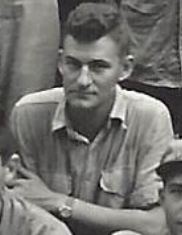
Major John E. McDonald from the Third Marine Regiment Staff picture in December 1943.
Photo likely taken by Sgt. Curtis E. Francis, Intelligence Section, HQ Co., Third Marine Regiment;
from Major Grant Crane Collection [Daniel M. Popek Collection].
Born: January 29, 1916 in Toledo, Ohio
Education: Jesup W. Scott High School, Toledo, Ohio
Bachelor of Arts in Business/Finance, University of Toledo, 1938
John E. McDonald was born in 1916 in Toledo, Ohio, the son of a salesman. Using Ancestry.com and some other sources,
I have been able to develop a rough outline of his life. John was on his High School swim team, then went to the
University of Toledo in Ohio. He was a member of Phi Kappa Chi Fraternity before graduating from the University of
Toledo with a Bachelor's Degree in Business/Finance. While a college student at Toledo, John enlisted as a Private
on June 6, 1935 in the Marine Corps Reserve. He went to the Platoon Leader's Unit, 9th Reserve District, Marine
Barracks, U.S. Naval Training Station, Great Lakes, Illinois which he graduated in 1939. John was commissioned as
a Second Lieutenant in the Marine Corps Reserve on February 8, 1939 and stayed with the 9th Reserve District.
Lieutenant McDonald joined HQ Company, 2nd Battalion, 2nd Marine Regiment at Camp Elliott, San Diego, California
by July 1941. He became the BN-4 (Logistics) for the 2nd Battalion.
In January 1942, Lieutenant McDonald embarked for American Samoa and joined the Service Company, Brigade
Special and Service Troops of the Second Marine Brigade as a logistics officer. By July 1942, John had been
promoted to Captain and was the Acting Assistant Quartermaster for the Second Marine Brigade on American Samoa.
On March 12, 1943, Captain McDonald was made the Regimental Quartermaster of the Third Marine Regiment. During
the Bougainville Campaign, John McDonald was promoted to Major on December 6, 1943. Major McDonald continued
with the Headquarters Company, Third Marine Regiment through the Guam Campaign. He was made the R-1 [Adjutant]
on January 4, 1944. After the Guam Campaign, John McDonald joined Major Grant Crane in travelling to San Diego,
California and became the R-4 for the 4th Infantry Training Regiment. Major McDonald followed Grant Crane to
Quantico in late 1945 and was returned to Reserve status.
John married Margaret E. (Hunter) Burrer, a Toledo divorcee whom John knew from High School, in 1946 in Toledo, Ohio.
They moved to San Jose, California, where John worked as an accountant. John is found on Marine Muster Rolls serving as
a Reserve officer in California from the 1950s to the 1960s. He was promoted to full Colonel on July 1, 1959. Colonel
McDonald retired from the Marine Corps Reserve in July 1965.
John and Margaret had a stepdaughter and two sons. John died in San Jose, California on April 16, 1990.
His wife died in September 2005 in San Jose.
If you are a relative and can provide more information, drop me an email (see link below). I would be happy to share
your information on this web page if you like.
Burial: Unknown
Sources:
USMC Muster Rolls, 1798 - 1958, NARA Microfilms T1118/T977.
Various Sources on Ancestry.com
September 2005 Obituary of Margaret Eloise (Hunter) (Burrer) McDonald on Legacy.com
Assistant R-4 [Logistics] Captain Frank Joseph Clarke, USMC [Bronze Star - Bougainville Campaign]

Captain Frank J. Clarke from the Third Marine Regiment Staff picture in December 1943.
Photo likely taken by Sgt. Curtis E. Francis, Intelligence Section, HQ Co., Third Marine Regiment;
from Major Grant Crane Collection [Daniel M. Popek Collection].
Born: May 30, 1918 in New York City, New York
Education: Unknown High School
Bachelor of Science Degree, Georgia Institute of Technology, Atlanta, Georgia, 1952
Master of Science Degree, Georgia Institute of Technology, Atlanta, Georgia, 1953
Ph.D., Urban Sociology, Emory University, Atlanta, Georgia, 1972
Dissertation: " Differential Views of Atlantans toward Zoning"
Frank grew up in Queens Village, Queens, New York City. He enlisted April 7, 1939 in the
Marine Corps Reserve and joined the Platoon Leaders Unit, 3rd Reserve District, Marine Base
New York. By August 1939, Frank was attending the Eastern Platoon Leaders Class at Quantico.
He rejoined the Platoon Leaders Unit in New York in 1940 while working at Turner Halsey Textile
Company in New York City. Frank remained with the Platoon Leaders Unit at New York City in 1941
with some training in Philadelphia during July 1941. After the Japanese bombed Pearl Harbor,
Frank arrived at the Marine Basic School in Philadelphia on January 10, 1942. Frank graduated
the Basic School and was commissioned as a Second Lieutenant in the Marine Corps Reserve. He
then went to the Marine Quartermaster Administration School at Quantico by April 1942.
Lieutenant Clarke joined the Headquarters Company of the Third Marine Regiment at New River,
North Carolina on July 17, 1942 and became the Regimental Munitions Officer. Frank accepted a
regular commission as a Second Lieutenant in the Marine Corps before September 1, 1942. The
Third Marines and Lieutenant Clarke travelled to American Samoa. Frank was promoted to First
Lieutenant on December 14, 1942 and was made the Assistant R-4 of the Third Marine Regiment. Frank
continued serving on New Zealand and Guadalcanal and was promoted to Captain on August 3, 1943.
Captain Frank Clarke was awarded a Bronze Star for his efforts as Assistant R-4 with the
Third Marines during the Bougainville Campaign. Captain Clarke continued as the Assistant
R-4 through the Guam Campaign. In January 1945, he was transferred to Provisional Motor
Transport Company, Headquarters and Service Battalion of the Pacific Fleet Marine Force.
Captain Clarke assumed command of C Company, Third Pioneer Battalion of the Third Marine
Division on Iwo Jima from March 1 to March 27, 1945. Frank went to the Marine Training
Command in San Diego in late April 1945. By August 1945, Captain Clarke returned to the
east coast and was made the Assistant Post Quartermaster for the Marine Barracks at Parris
Island.
In 1947, Frank Clarke joined the Amphibious Training Command at the U.S. Naval Amphibious Base,
Little Creek, Virginia as a supply officer. Frank was promoted to Major by April 1948 and moved
as a supply officer to the Marine Barracks, Norfolk Naval Station, Portsmouth, Virginia. Major
Clarke was assigned to Henderson Hall in Arlington, Virginia in 1950. Apparently, he was detached
to Georgia Institute of Technology in Atlanta to get a Bachelor of Science degree which he earned
in 1952. Frank was promoted to Lieutenant Colonel on March 5, 1952. Frank earned a Master of
Science degree from Georgia Tech in 1953. He joined the First Marine Division in Korea in the
summer of 1954 and returned to California in 1955. In 1956, Lieutenant Colonel Clarke joined
the Marine Barracks at Philadelphia Navy Base and served there through 1958 [the last year of
NARA Microfilm T977]. Frank retired from active duty in February 1962.
Frank Clarke joined the faculty of Georgia Tech as an Assistant Professor by 1964 in the
Department of Textile Engineering. He became an Associate Professor and earned a Ph.D. in
Urban Sociology from Emory University in 1972. Frank married Laura Jean Johnston in September
1945 and had at least two daughters. Colonel Clarke had a management consulting business as well.
Frank wrote a book "Study of Building Material Shortages" which was published by Georgia Tech
in 1974. Frank died in Atlanta on May 24, 1983.
Burial: Arlington National Cemetery
Sources:
USMC Muster Rolls, 1798 - 1958, NARA Microfilms T1118/T977.
Georgia Institute of Technology Yearbook 1951
Newspaper Article, "Big Celebration at Parris Island," The Greenville News (Greenville, South Carolina),
August 16, 1945.
Newspaper Article, "Dr. Crawford heads [Georgia] Tech Physics Setup," The Atlanta Constitution (Atlanta,
Georgia), July 11, 1964.
Newspaper Article, "Dr. Frank J. Clarke Obituary," The Atlanta Constitution (Atlanta, Georgia),
May 26, 1983.
Regimental Communications Officer Major Robert Custis Walker, USMCR [Purple Heart / Legion of Merit - Bougainville Campaign]

Photo of Robert Custis Walker from Eastern High School, Washington DC 1934 Yearbook.
Born: November 30, 1916 in Washington Grove, Montgomery County, Maryland
Education: Eastern High School, Washington, D.C., Class of 1934
Attended George Washington University in Washington, D.C. 3 years
Robert was born in Maryland and went to high school in Washington, D.C. He enlisted in the Marine
Corps Reserve on February 20, 1933 while still in high school. Robert joined Company G, 23rd Marine
Reserve Regiment as a Private. By late 1934, Robert was in Company F, 5th Marine Reserve Battalion at
Rockville, Maryland. Company F was commanded in late 1935 by Captain Ralph M. King, USMCR, who would
lead 3rd Battalion, 3rd Marines on Bougainville in November 1943. Robert was promoted to Private First
Class by October 1936.
On April 1, 1937, Robert C. Walker was promoted to Corporal in Company F, 5th Reserve Battalion. Still
in Company F under the command of Capt. Ralph M. King, Robert was promoted to Sergeant by July 1938.
Robert won the "Daughters of the War of 1812 Award" for "...soldierly appearance, attendance at camp
drills in the armory training year, the manual of arms, rifle marksmanship, progress in the professional
correspondence courses and recruiting interests in the reserves..." in August 1938 (Newspaper Article,
"Parade to bring Camp to Close," Evening Star (Washington, D.C.), August 20, 1938). From January 5 to
March 22, 1939, Sergeant Walker served active duty with A Company, First Battalion, Fifth Marine Regiment,
Fleet Marine Force, off the Virgin Islands for training with Fifth Reserve Battalion Executive Officer
Captain William Wallace Stickney [1899 - 1980; Stickney would command 2nd Battalion, First Marines on
Guadalcanal in 1942] and some other select reserve Marine NCOs.
On February 8, 1940, Robert was promoted to First Sergeant of F Company, 5th Marine Reserve Battalion.
Commissioned a Second Lieutenant in the Marine Corps Reserve on July 9, 1940, Robert C. Walker was
assigned to B Company, 5th Reserve Battalion. On January 21, 1941, Lieutenant Walker served with
M Company, 3rd Battalion, 7th Marines at Guantanamo Bay, Cuba. By April 1941, Lieutenant Walker was
the Battalion Communications Officer for Headquarters Company, 1st Battalion, 5th Marine Regiment at
Quantico. Robert served in the summer of 1941 on the destroyer USS Colhoun (DD-85) near Miami, Florida.
Lieutenant Walker was sent to the U.S. Army Signal Corps School at Fort Monmouth, New Jersey in October
1941.
After graduating from the U.S. Army Signal Corps School, Robert joined Headquarters Company,
3rd Battalion, Eighth Marine Regiment at San Diego, California on January 2, 1942 as the Battalion
Communications Officer. Three days later the battalion embarked on the liner SS Monterey and sailed
for American Samoa, arriving on January 19, 1942. Robert C. Walker was promoted to First Lieutenant
on April 15, 1942 and Captain in May 1942. Captain Robert C. Walker was transferred to Headquarters
Company, Third Marine Regiment on September 22, 1942 and was made the Regimental Communications
Officer. Robert continued as the Regimental Communications Officer on New Zealand and Guadalcanal.
Robert Walker was promoted to Major on August 6, 1943 on Guadalcanal.
Major Walker served through the entire Bougainville Campaign. He was awarded the Legion of Merit
for his leadership in repairing the regimental telephone wires through heavy enemy artillery bombardments
during the Battle of Piva Forks. Robert was wounded by artillery fire at Bougainville on November 25, 1943,
although the group photo above in December 1943 shows the wound was not serious [it was reported that he
had to use crutches for a time]. He was medically evacuated to California in January 1944 possibly for
filariasis. After recuperating, Major Walker commanded the Field Signal Battalion, Specialist Training
Regiment at Camp Pendleton, California by July 1944. He continued with this unit until late 1945, when
he joined Battalion Headquarters of the First Marine Division in Tientain, China as a signal officer.
Robert returned to the East Coast of America by January 1947 as a signal officer with Marine Amphibious
Training Command, U.S. Naval Amphibious Base, Little Creek, Virginia. In April 1949, Major Walker was
transferred to Marine Headquarters in Washington, D.C.
Robert went to Henderson Hall in Arlington, Virginia beginning in January 1950 where he likely took college
classes at George Washington University. Promoted to Lieutenant Colonel on February 1, 1950, Robert
continued at Henderson Hall until October 1952 when he moved to Camp Lejeune and the Joint Landing Force
Board. By late 1955, Colonel Walker joined the Marine Corps Education Command at Quantico. Robert next
travelled overseas to Okinawa and served with the Third Marine Division in late 1956. By January 1958,
Robert returned to Camp Lejeune and worked as a communication officer for 2nd Marine Division. He was
promoted to full Colonel in August 1958.
Colonel Walker became Deputy Director of the Ninth Marine Reserve District with an office at Kansas City,
Missouri in September 1960. He inspected and toured Marine units in the 13 states of this district.
Retiring on May 31, 1961, Colonel Walker moved his family to Europe touring West Germany, Switzerland,
Austria, and Italy before staying in southern France for at least three years. What he did after this
time period I have not been able to find out yet. Robert Walker married Elizabeth "Bette" Burch [1918 - 2011]
and had two sons and a daughter. Colonel Walker died on October 13, 1983.
Burial: Unknown
Sources:
USMC Muster Rolls, 1798 - 1958, NARA Microfilms T1118/T977.
Eastern High School [Washington, D.C.] Yearbook 1934
Newspaper Article, "Parade to Bring Camp to Close," The Evening Star (Washington, D.C.), August 20, 1938.
Newspaper Article, "Fifth Marine Riflemen keep Perfect Score," The Evening Star (Washington, D.C.),
December 25, 1938.
Newspaper Article, "Capt. Stickney to go on Active Duty with Fleet Marine Force," The Evening Star
(Washington, D.C.), January 8, 1939.
Newspaper Article, "80 Qualify as Officers," The Baltimore Sun (Baltimore, Maryland), January 15, 1941.
Newspaper Article by Sgt. Charles P. Evans [USMCR, Combat Correspondent, HQ Co., Third Marine Regiment],
"Maj. returns from Front on Crutches, gets Medal," The Daily Times (Salisbury, Maryland), March 14, 1944.
Newspaper Article, "Col. Robert C. Walker Deputy Director of 9th Marine Corps Reserve," The Kansas City Star
(Kansas City, Missouri), September 1, 1960.
Newspaper Article, "Col. Walker to Inspect Marine Unit," The La Crosse Tribune (La Crosse, Wisconsin),
December 4, 1960.
Newspaper Article by Bill Moore, "A Venture to Experience another Kind of Living," The Kansas City Star
(Kansas City, Missouri), May 19, 1961.
Regimental Gas and Ordnance Officer Captain John Williamson Winford, USMCR

Photo of Marine Lieutenant John W. Winford about 1918 from Nashville Banner newspaper of
February 12, 1919. He won a Battlefield Commission for his bravery in World War 1.

Captain John W. Winford from the Third Marine Regiment Staff picture in December 1943.
Photo likely taken by Sgt. Curtis E. Francis, Intelligence Section, HQ Co., Third Marine Regiment;
from Major Grant Crane Collection [Daniel M. Popek Collection].
Born: December 6, 1896 in Nashville, Tennessee
Education: Hume-Fogg High School, Nashville, Tennessee, Class of 1915
John grew up in Nashville, Tennessee, the son of a train engineer. He enlisted into the
Marine Corps on May 16, 1917 and was trained at Parris Island. John joined the 81st Company
of the First Marine Machine Gun Battalion at Quantico on August 1, 1917. By January 1918, the
81st Company and John were in France as part of the 6th Marine Machine Gun Battalion. On March 15,
the 81st Company moved to the front lines in support of Second Battalion, Sixth Marine Regiment.
The Company took heavy casualties in June 1918 particularly from German artillery fire during
the Aisne River defense in the Chateau-Thierry area. John was promoted to Corporal on
July 12, 1918 after earning a Silver Star Medal for bravery from June 6 to July 10, 1918
at Chateau-Thierry.
Corporal John W. Winford won a second Silver Star Medal for bravery from July 18 to 22, 1918
at Soissons [Vierzy], France. He was given a Battlefield Commission to Second Lieutenant in
the Marine Corps Reserve on September 25, 1918 after the American St. Mihiel attack was completed.
The 6th Marine Machine Gun Battalion participated in the American Meuse-Argonne offensive from
October to the armistice on November 11, 1918. The unit went to Germany as an occupation force
until July 1919. On March 8, 1919, Lieutenant Winford won a French Army Croix de Guerre for
gallantry in action on June 9, 1918 at Chateau-Thierry. He won a second French Army Croix de
Guerre on March 31, 1919 for gallantry in action on October 10, 1918 near Blanc Mont Ridge.
On April 2, 1919, Lieutenant Winford was given a regular commission in the Marine Corps.
John W. Winford travelled to Quantico in August 1919 and was discharged from the Marine Corps
on August 14, 1919. John worked as a civil engineer and lived in Salisbury, North Carolina
with his wife Hazel and daughter in 1930. By 1940, John had moved to Salem, Virginia and was
working as a clay pipe salesman. John was called back to active duty in April 1942.
John Winford was appointed a First Lieutenant in the Marine Corps Reserve and reported to
the Marine Training Center at Quantico on April 17, 1942. In late spring 1942, Lieutenant
Winford was a student at the U.S. Army Chemical Warfare School at the Edgewood Arsenal [Aberdeen
Proving Ground] in Maryland. John Winford was promoted to Captain and joined the Second Marine
Brigade on American Samoa as the Brigade Gas and Chemical Warfare Officer by September 1942.
Captain Winford transferred to Headquarters Company, Third Marine Regiment as the Regimental Gas
and Ordnance Officer on March 12, 1943. He served through the entire Bougainville Campaign and
did not get sick or wounded. John was promoted to Major on July 4, 1944. After landing on
Guam on July 21, 1944, Major Winford was wounded seriously by artillery fire in the knee, hip,
and neck on July 22, 1944. He was medically evacuated from the island the next day.
Major John Winford recuperated from his wounds at the Navy Hospital in Bethesda, Maryland until
February 1946 when he was retired from the Marine Corps. According to a newspaper article, John
enlisted in the U.S. Army later in 1946 and served in Germany with the American occupation forces.
He returned to the U.S. and visited his mother in Tennessee in March 1947. John was a salesman
after the war. He died on November 29, 1986 in Salem, Virginia.
Burial: Sherwood Memorial Park, Salem, Virginia
Sources:
USMC Muster Rolls, 1798 - 1958, NARA Microfilms T1118/T977.
Newspaper Article, "Large Class of Graduates," The Nashville Banner (Nashville, Tennessee),
June 5, 1915.
Newspaper Article, "Nashville Boy wins Promotion," The Nashville Banner (Nashville, Tennessee),
October 22, 1918.
Newspaper Article, "John Winford, Marine, is Elevated in Ranks," The Tennessean (Nashville,
Tennessee), October 22, 1918.
Newspaper Article, "Nashville Boy is Cited Again," The Nashville Banner (Nashville, Tennessee),
February 12, 1919.
Newspaper Article, "Last Rites held for Frank Winford," The Nashville Banner (Nashville,
Tennessee), February 18, 1927.
Newspaper Article, "Called to Active Duty," The News Leader (Staunton, Virginia), April 26, 1942.
Newspaper Article, "Navy Lists 8 Casualties," The Daily Press (Newport News, Virginia),
August 25, 1944.
Newspaper Article, "How Swell [John Winford returns from Germany]," The Tennessean
(Nashville, Tennessee), March 5, 1947.
Assistant Regimental Quartermaster / QM Clerk [Marine Gunner] Warrant Officer William Francis Pollak Jr., USMC

Marine Gunner William F. Pollak Jr. from the Third Marine Regiment Staff picture in December 1943.
Photo likely taken by Sgt. Curtis E. Francis, Intelligence Section, HQ Co., Third Marine Regiment;
from Major Grant Crane Collection [Daniel M. Popek Collection].
Born: October 19, 1919 in Douglas, Arizona
Education: Douglas High School ?, Douglas, Arizona
William grew up in Douglas, Arizona. His father served as a Lieutenant in the U.S. Army in World War 1.
William Jr. enlisted into the Marine Corps on June 13, 1939. He went to boot camp at San Diego and by
September 1939 was assigned to A Company, 1st Battalion, 6th Marine Regiment at San Diego. He was
promoted to Private First Class by June 1940. On June 22, 1940, William was transferred to Headquarters
Company of 1/6 and became a Quartermaster Clerk for the Battalion. He was promoted to Corporal on
August 5, 1940 and remained with the Quartermaster section.
Promoted to a Sergeant on November 29, 1940, William moved up to Headquarters Company of 1st Battalion,
6th Marines as a Quartermaster Clerk. Sergeant Pollak was transferred again by July 1941 to Headquarters
Company, Second Service Battalion, Division Service Troops, Second Marine Division at San Diego, where he
worked in the commissary storeroom. After the Pearl Harbor attack, William travelled to the Service
Company, Brigade Special and Service Troops, Second Marine Brigade on American Samoa in January 1942.
Sergeant Pollak worked as a clerk in the commissary. He was promoted to Staff Sergeant by April 1, 1942,
and Supply Sergeant on July 1, 1942.
Continuing work as a commissary clerk on American Samoa, William Pollak was promoted to Quartermaster
Sergeant on October 19, 1942. By March 1, 1943, Sergeant Pollak was advanced to Quartermaster Clerk;
he was transferred to Headquarters Company, Third Marine Regiment on March 23, 1943 and became an Assistant
Regimental Quartermaster. During the first month of the Bougainville Campaign, William was made a
Warrant Officer [Marine Gunner] continuing with his Assistant Regimental Quartermaster work.
William was healthy and remained with the Headquarters Company of the Third Marine Regiment through
the Guam Campaign. In January 1945, Marine Gunner Pollak got some well-earned leave in the United
States. He rejoined the Headquarters Company of the Third Marines in the spring of 1945. By July 1945,
William returned to Service Battalion, Marine Base San Diego as an assistant to the Base Clothing Officer.
By April 1946, William served with the Marine Training and Replacement Command at Camp Pendleton before
joining the Marine Corps Supply Depot on the same base. William was advanced to Chief Warrant Officer
on October 3, 1947.
William continued at Marine Corps Supply Depot at Camp Pendleton until August 1951, when he as transferred
to the Headquarters Battalion of the First Marine Division in Korea which was engaged in combat operations.
William Pollak was promoted to Second Lieutenant in October 1951 in Korea. By July 1952, Lieutenant Pollak
had returned to Marine Corps Supply Depot at Camp Pendleton as a supply officer. He was promoted to First
Lieutenant by January 1953 and Captain on December 16, 1953. Captain Pollak was a supply officer at Marine
Corps Supply Depot in San Francisco in April 1954. He had temporary duty to Pearl Harbor (Camp H.M. Smith)
from 1957 to 1958 [end of Microfilm T977].
Captain William Pollak retired from Marine Corps active duty in January 1962 with over 20 years of service.
He became a Foreign Service Officer with USAID and was assigned to the Orient. William married
Bernadett A. Auth in 1945 and had one son and two daughters. His son served four years in the Marine Corps.
William's mother Irene served in the Women's Army Corps during World War 2. Captain William Pollak died of
a heart attack on May 15, 1973 while serving as an USAID Officer in Vientiane, Laos.
Burial: Cimetiere Catholique, Vientiane, Laos [Unknown if body was removed for burial in U.S.]
Sources:
USMC Muster Rolls, 1798 - 1958, NARA Microfilms T1118/T977.
American Foreign Service Report of Death of American Citizen William Francis Pollak, May 19, 1973.
Newspaper Article, "Arizona WAC Private [Irene] Pollak," Arizona Daily Star (Tucson, Arizona),
August 20, 1944.
Assistant Regimental Munitions Officer [Marine Gunner] Warrant Officer James Hugh Greer, USMC

Marine Gunner James H. Greer from the Third Marine Regiment Staff picture in December 1943.
Photo likely taken by Sgt. Curtis E. Francis, Intelligence Section, HQ Co., Third Marine Regiment;
from Major Grant Crane Collection [Daniel M. Popek Collection].
Born: December 11, 1902 in Neelyville, Missouri
Education: Neelyville High School ?, Neelyville, Missouri
James grew up on farms in northern Arkansas and southern Missouri. He enlisted into the Marine Corps
on April 8, 1926. Private Greer was assigned to the Marine Barracks at the Pearl Harbor Navy Base in
Hawaii by summer. On August 1, 1926, James was promoted to Corporal. James Greer became a Sergeant
on March 12, 1929 at Pearl Harbor, Hawaii. James was transferred to Guard Company 1, Marine Barracks,
Mare Island Navy Yard, California on June 13, 1929. He was sick from June 25 to 28, 1929 at the Naval
Hospital on Mare Island.
On September 1, 1929, Sergeant Greer was sent to Casualty Company 1, Marine Corps Base at San Diego for
sickness. Two months later, he was transferred to Recruit Depot San Diego as a Drill Instructor. James
was discharged from the Marine Corps upon the end of his enlistment on April 7, 1930; he was awarded a
good conduct medal.
James Greer reenlisted in the Marine Corps in Missouri on October 2, 1930 as a Private. He was assigned
to the Marine Detachment on the USS Lexington aircraft carrier in November 1930 and worked at the rifle
range at Fort Lewis, Washington. James was promoted to Corporal on December 1, 1930 and returned to the
ship. In February 1931, the USS Lexington went to the Panama Canal with Corporal Greer serving with
the Marine Detachment onboard. The USS Lexington cruised through the Panama Canal to Guantanamo Bay,
Cuba in March 1931. The ship reversed course back through the Canal to San Pedro, California the next
month. James remained on the USS Lexington and was promoted to Sergeant on August 1, 1931. The ship
cruised to Bremerton, Washington in September 1931 before returning to California by November 1931.
The USS Lexington steamed to Hawaii in February 1932 before returning to California in March 1932.
Sergeant Greer requalified as an expert rifleman in April 1932 while still a member of the USS Lexington
Marine Detachment off Washington State. In late June 1932, the USS Lexington returned to California
waters. Sergeant Greer was transferred to Recruit Depot San Diego on November 4, 1932 before joining
the Marine Barracks at Naval Ammunition Depot in Puget Sound, Washington by January 1933.
Sergeant Greer served at the Puget Sound Naval Ammunition Depot until October 3, 1933, when he was
transferred to the cruiser USS Augusta (CA-31). The USS Augusta got underway for China on
October 20, 1933; the ship stopped at the ports of Shanghai, Amoy, and Hong Kong in China during
November 1933. The USS Augusta went to the Philippines in December 1933, and Sergeant Greer
was the Police Sergeant of the Marine Detachment onboard. On March 29, 1934, the USS Augusta
steamed for Shanghai, China. The ship next cruised to Tsingtao, China on May 24, 1934. In June
1934, the USS Augusta travelled to Yokohama and Kobe, Japan before returning to Tsingtao, China.
On September 18, 1934, Sergeant James Greer joined A Company of the Marine Detachment at the American
Legation at Peking [Beijing], China. Sergeant Greer became a Platoon Leader of A Company in November
1935. On May 13, 1936, James Greer was promoted to Platoon Sergeant of A Company in Peking, China.
On December 27, 1936, Platoon Sergeant Greer boarded the USS Chaumont for transportation to Marine
Barracks at Mare Island Navy Yard in California. Upon arrival at Mare Island, James was transported
to the Marine Barracks at the Norfolk Navy Yard in Portsmouth, Virginia.
From April 23 to June 1, 1937, Sergeant James Greer competed at rifle and pistol matches at Quantico.
On June 1, 1937, James was promoted to a Staff Sergeant and went to the Marine Clerk Correspondence
School at Quantico. James continued at the Clerk Correspondence School until September 20, 1937.
James reenlisted in the Marine Corps on October 2, 1937 and after temporary duty at Manassas, Virgina,
he returned to the Marine Clerk Correspondence School on October 11, 1937. Staff Sergeant Greer
continued at Clerk Correspondence School until August 1, 1938, when he became an Instructor at the
School. On December 5, 1938, James was transferred to C Company, 1st Battalion, 5th Marine Regiment;
his rank reverted to Platoon Sergeant.
The First Battalion moved from Quantico to Norfolk, Virginia and boarded the USS New York (BB-34), which
steamed to Puerto Rico in January 1939. The battleship also made stops at St. Thomas, Virgin Islands
and Martinique before returning to Culebra, Puerto Rico, where the battalion disembarked for Camp A.W.
Johnson. C/1/5 left Puerto Rico on the USS New York on March 13, 1939 and returned to Quantico.
On April 18, 1939, James qualified as a Sharp Shooter at Quantico. Promoted to a Gunnery Sergeant
on October 28, 1939, James Greer continued with C/1/5 at Quantico.
1st Battalion, 5th Marines travelled to Puerto Rico from January to March 8, 1940, when they cruised
back to Quantico. In late September 1940, Gunnery Sergeant Greer and 1/5 sailed to Guantanamo Bay
in Cuba. James was treated for a sickness from October 31 to November 1, 1940 in Cuba. Later in
November 1940, the Battalion embarked on USS Henderson (AP-1) for exercises off Puerto Rico which
continued to February 1941. James was sick at Guantanamo Bay much of January 1941. Sea exercices
for 1st Battalion, 5th Marines continued off the southeastern United States in spring and summer of
1941.
James was discharged from his enlistment on October 1, 1941; he was awarded another good conduct
medal. Reenlisting into the Marine Corps on October 2, 1941, James was reappointed as a Gunnery
Sergeant and rejoined C Company, 1st Battalion, 5th Marines at Quantico. In early 1942, Sergeant
Greer was assigned to the Marine Detachment at the American Embassy in London, England. He was
detached to Scotland for training in April 1942. James was promoted to Master Gunnery Sergeant
and was sent back to Washington, D.C. before joining the Headquarters Company of Third Marine
Regiment at New River, North Carolina on July 1, 1942.
James travelled with the regiment to American Samoa and served as the Chief NCO of the Regimental
Armory. James was commissioned a Marine Gunner [Warrant Officer] on March 16, 1943 and was made
the Regimental Munitions Officer and later Assistant Regimental Munitions Officer. Gunner Greer
served through the whole Bougainville Campaign. On February 19, 1944 on Guadalcanal, James was
sent to the field hospital for a sickness. Evacuated to the United States in early March 1944,
James Greer went first to a Navy Hospital in Oakland then to a Navy Hospital in San Diego by late
April 1944. He died in the Navy Hospital in San Diego on September 11, 1944 leaving a wife, Eleanor.
Burial: Arlington National Cemetery
Sources:
USMC Muster Rolls, 1798 - 1958, NARA Microfilms T1118/T977.
Regimental Surgeon Lieutenant Commander Luther Irvin Fisher, M.D., USNR "Fish"

Photo of Luther Fisher from Jefferson Medical College [Philadelphia] Yearbook of 1927.
Born: September 12, 1901 in Loys Station [East of Thurmont], Frederick County, Maryland
Education: Waynesboro High School, Waynesboro, Pennsylvania
Pre-Med Degree at Gettysburg College, Gettysburg, Pennsylvania, Class of 1923
Doctor of Medicine, Jefferson Medical College, Philadelphia, Pennsylvania, Class of 1927
Luther grew up in rural Frederick County, Maryland and moved to Waynesboro, Pennsylvania
in 1905. The son of a farmer, Luther Fisher attended Gettysburg College and went to
Jefferson Medical College in Philadelphia. Luther was a member of the Ross V. Patterson
Medical Society at the Medical College. Luther married Ruth B. Bender of Gettysburg,
Pennsylvania on September 12, 1925. After earning his Doctor of Medicine degree in 1927,
Luther interned at Polyclinic Hospital [University of Pennsylvania] in Philadelphia until 1929.
Luther accepted a position in Internal Medicine at St. Luke's Hospital in Bethlehem, Pennsylvania,
and he became the Chief of Medicine there beginning in 1935. On June 26, 1941, Luther was
commissioned a Lieutenant Commander in the U.S. Navy Reserve as a Medical Officer. After the
Japanese attacked Pearl Harbor, Luther was called to active duty with the U.S. Navy Medical Corps.
He worked at the U.S. Navy Hospital in Philadelphia from December 29, 1941 to May 30, 1942. The
Navy sent him to North Carolina to join the newly forming Third Marine Regiment in June 1942.
Luther travelled with the Third Marine Regiment as the Regimental Surgeon to American Samoa in
September 1942. In November 1942, Dr. Fisher was detached to the Second Marine Brigade
Headquarters and later the Third Marine Medical Battalion. He rejoined the Third Marine
Regiment as Regimental Surgeon on August 7, 1943. Lt. Commander Fisher served through the
entire Bougainville Campaign and helped save several wounded Marines' lives. He was sent
on leave back to the United States from Guadalcanal on January 12, 1944.
Doctor Fisher was promoted to Commander in early 1944 and returned to the Navy Hospital in
Philadelphia on March 17, 1944; he served there until May 6, 1944. The Navy sent him to the
Navy Hospital in Quantico, where Luther served a year from May 11, 1944 to May 16, 1945. The
U.S. Navy had one additional overseas assignment for Luther as they sent him to Naval Fleet
Hospital No. 114 at Mercedes, southern Samar Island, Philippines. Commander Fisher worked at
this hospital from June 12, 1945 to October 26, 1945. After returning to the United States,
Luther separated from Naval Active Duty on February 16, 1946.
Doctor Fisher returned to his job at Saint Luke's Hospital in Bethlehem, Pennsylvania.
He resigned from his position as Chief of Medicine in 1956 but continued his practice in
Internal Medicine until 1976, when he retired. Luther had one son with his wife Ruth, and
they were members of the First Presbyterian Church in Bethlehem. Luther Fisher died on
September 11, 1989 in Pennsylvania.
Burial: Nisky Hill Cemetery, Bethlehem, Pennsylvania
Sources:
USMC Muster Rolls, 1798 - 1958, NARA Microfilms T1118/T977.
Jefferson Medical College Yearbook of 1927.
Pennsylvania Application for Veteran Compensation, Luther Irvin Fisher, June 22, 1950.
Newspaper Article, "Bender-Fisher Nuptials Read," The Gettysburg Times (Gettysburg,
Pennsylvania), September 14, 1925.
Newspaper Article, "Navy Calls Physician at St. Luke's Hospital," The Morning Call
(Allentown, Pennsylvania), December 27, 1941.
Newspaper Article, "Miss Nina B. Fisher Obituary," The News (Frederick, Maryland),
August 23, 1949.
Newspaper Article, "St. Luke's Appoints Medical Dept. Head," The Morning Call
(Allentown, Pennsylvania), May 29, 1956.
Newspaper Article, "Dr. Luther Fisher Obituary," The Morning Call (Allentown,
Pennsylvania), September 12, 1989.
Assistant Regimental Surgeon Lieutenant Chauncey Kay McGeorge, M.D., USNR [Bronze Star - Bougainville Campaign]

Photo of Chauncey McGeorge from Temple University [Philadelphia] Yearbook of 1940.
Born: October 25, 1914 Coraopolis [near Pittsburgh], Pennsylvania
Education: Steubenville High School ?, Steubenville, Ohio
Bachelor of Science, Chemistry, Westminster College, New Wilmington, Pennsylvania, Class of 1936
Doctor of Medicine, Temple University, Philadelphia, Pennsylvania, Class of 1940
Chauncey was the son of a respected Presbyterian Minister and grew up in Steubenville,
Ohio. His father took a position in 1932 as pastor of the Second United Presbyterian
Church in New Castle, Pennsylvania. After graduating High School, Chauncey attended
Muskingum College in New Concord, Ohio from 1932 to 1933. He transferred to Westminster
College in New Wilmington, Pennsylvania and graduated with a Bachelor of Science degree
in Chemistry.
Chauncey was accepted to Temple University Medical School in Philadelphia. His father
became the pastor of First Presbyterian Church of Cambridge, Ohio in 1937. After
completing his Doctor of Medicine degree in 1940, Chauncey interned at Jameson Memorial
Hospital in New Castle, Pennsylvania and later Philadelphia General Hospital. Chauncey
was commissioned as a Lieutenant Junior Grade in the U.S. Navy Reserve on June 3, 1942.
He joined the Headquarters Company of the Third Battalion, 21st Marines at New River,
North Carolina on July 16, 1942 as a Medical Officer.
Lieutenant McGeorge was transferred to Headquarters Company, Second Battalion, Third
Marines as the Assistant Battalion Surgeon and travelled with the Third Marine Regiment
to American Samoa in September 1942. Chauncey was made the Battalion Surgeon of 2/3 in
November 1942. On April 13, 1943, Lieutenant McGeorge was transferred to Headquarters
Company, Third Marine Regiment as the Assistant Regimental Surgeon. Chauncey was promoted
to a full Lieutenant on May 1, 1943.
Chauncey served through the entire Bougainville Campaign and helped save wounded Marine
lives. He won a Bronze Star which citation reads: "During the Battle of Piva Forks,
Bougainville, the field hospital in which Lieutenant McGeorge was performing a delicate
operation was subject to heavy concentration of enemy mortar fire. Realizing that a
delay in the operation might cost the life of his patient, and despite the danger of
mortar shells exploding nearby, he remained at his post and successfully completed his
work..."
On January 29, 1944, Lieutenant McGeorge was transferred to U.S. Navy Mobile Hospital
Number 8 on Guadalcanal, then U.S. Navy Base Hospital Number 6 on Espiritu Santo Island.
On February 6, 1944, Chauncey boarded and served as a Medical Officer on the S.S. Hawaiian
Shipper which sailed to San Francisco. In late February, Lieutenant McGeorge served at a
Naval Hospital in the United States (most likely Philadelphia Naval Hospital) until
March 2, 1946. He was promoted to Lieutenant Commander on October 3, 1945. Chauncey was
released from active duty on August 19, 1946 at Philadelphia.
Doctor McGeorge became a Radiologist after World War 2, moving to Moorestown, New Jersey
in 1949. Chauncey accepted a position as the Chief of Radiology at Our Lady of Lourdes
Hospital in Camden, New Jersey. He was a respected physician and treated some famous
patients including Baseball player Stan Musial in 1957. In addition to his hospital work,
Doctor McGeorge established a private practice in Haddonfield, New Jersey. He retired at
age 80. Chauncey McGeorge was married to Marilyn Faye Amstutz [1924 - 2018; Ohio State
University graduate] and had three daughters. Doctor McGeorge died on October 27, 2001 in
Moorestown, New Jersey.
Burial: First Presbyterian Church of Moorestown Cemetery, Moorestown, New Jersey
Sources:
USMC Muster Rolls, 1798 - 1958, NARA Microfilms T1118/T977.
Temple University Medical Yearbook of 1940.
Pennsylvania Application for Veteran Compensation, Chauncey Kay McGeorge, March 13, 1950.
Newspaper Article, "County has 21 in Westminster Senior Class," New Castle News (New Castle,
Pennsylvania), June 3, 1936.
Newspaper Article, "Dr. C.K. McGeorge Resigns as Pastor of Second Church," New Castle News
(New Castle, Pennsylvania), March 29, 1937.
Newspaper Article by PFC Cyril O'Brien [Combat Correspondent, Third Marine Regiment], "Mortar
Fire Fails to Daunt Cambridge [Ohio] Man," The Times Recorder (Zanesville, Ohio), June 2, 1944.
Newspaper Article, "Dr. Chauncey Kirk McGeorge Obituary," Times Signal (Zanesville, Ohio),
December 13, 1955.
Newspaper Article/Photo, "Injury Sidelines Stan 'the Man,' ," Delta Democrat Times (Greenville,
Mississippi), August 26, 1957.
Newspaper Article, "Sparkling Event Draws Patrons of [Our Lady of Lourdes] Hospital," Courier-
Post (Camden, New Jersey), November 20, 1967.
Newspaper Article, "C.K. McGeorge, 87, Respected Radiologist [Dr. Chauncey Kay McGeorge Obituary],"
The Philadelphia Inquirer (Philadephia, Pennsylvania), October 30, 2001.
Newspaper Article, "Marilyn Amstutz McGeorge [Obituary]," The Philadelphia Inquirer (Philadelphia,
Pennsylvania), July 8, 2018.
Regimental Dental Officer Lieutenant Herbert Alexander Smith, D.D.S., USNR [Bronze Star - Bougainville Campaign]

Photo of Lieutenant Commander Herbert Smith from March 3, 1946 Montgomery Advertiser Newspaper article.
Born: August 16, 1907 Prattville, Alabama
Education: Autauga County High School, Prattville, Alabama
Bachelor's Degree ?, University of Alabama, Tuscaloosa
Doctor of Dental Surgery, Atlanta Southern Dental College, Atlanta, Georgia, Class of 1932
Herbert grew up in Prattville, northwest of Montgomery, Alabama, the son of a farmer. After
graduating high school, Herbert attended and graduated from the University of Alabama. He next
went to the Atlanta Southern Dental College where he earned a Doctor of Dental Surgery in 1932.
Herbert established his own dental practice in Clayton, Alabama in 1936.
Direct commissioned as a Lieutenant Junior Grade in the U.S. Navy Reserve on June 17, 1941,
Herbert was called to active duty in March 1942. He became a Dental Officer at Jacksonville
Naval Air Base in Florida. Promoted to full Lieutenant in July 1942, Herbert married Johanna
Hall [1911 - 1999] of Montgomery, Alabama on August 8, 1942. He joined the First Replacement
Battalion at New River, North Carolina on October 26, 1942. Herbert then travelled to American
Samoa late in 1942 and served the Headquarters Company of the Third Marine Regiment in January
1943 as the Regimental Dental Officer.
Lieutenant Smith participated in the entire Bougainville Campaign. He earned a Bronze Star for
setting up a temporary field hospital for Marines of First Battalion, Third Marines on Torokina
Point during the initial landing on November 1, 1943. After the field hospital was surrounded by
enemy forces and medical supplies were used up, Herbert ran across enemy lines to find additional
medical equipment. He then led other Medical Officers and Naval Corpsmen back across enemy lines
to his temporary hospital site. Later in the day, the temporary field hospital was relieved by
Marine reinforcements and nearby Japanese soldiers were routed.
The Third Marine Regiment and Lieutenant Smith withdrew to Guadalcanal in late December 1943 to
refit. Herbert continued with the Third Marines through the Guam Campaign. After the Guam
operation, Lieutenant Herbert Smith returned to the U.S. Naval Air Station in Jacksonville,
Florida. He finished his Naval duty at Tampa, Florida training Navy dentists for foreign
deployment. Herbert left active duty in early 1946. He set up a successful private dental
practice in Montgomery, Alabama. Herbert and his wife had one daughter. Herbert died of an
illness in the Montgomery area on November 9, 1973.
Burial: Greenwood Cemetery, Montgomery, Alabama
Sources:
USMC Muster Rolls, 1798 - 1958, NARA Microfilms T1118/T977.
Atlanta Southern Dental College Yearbook of 1929.
Newspaper Advertisement, "Dr. Herbert A. Smith Dentist," The Clayton Record (Clayton,
Alabama), April 24, 1936.
Newspaper Advertisement, "[Dr. Herbert A. Smith] Notice to Patients!," The Clayton Record
(Clayton, Alabama), March 27, 1942.
Newspaper Article, "Dr. Herbert Smith Made Lieutenant," The Prattville Progress (Prattville,
Alabama), July 2, 1942.
Newspaper Article, "Miss Hall and Lieut. Smith are Wed at Home Ceremony," The Montgomery
Advertiser (Montgomery, Alabama), August 9, 1942.
Newspaper Article, "Herbert Smith Decorated for Valor in Battle Area," The Prattville
Progress (Prattville, Alabama), May 4, 1944.
Newspaper Article, "Doctor Returns," The Montgomery Advertiser (Montgomery, Alabama),
March 3, 1946.
Newspaper Article, "Montgomerian Presents Oral Surgeon Clinic," Alabama Journal
(Montgomery, Alabama), March 5, 1953.
Newspaper Article, "Oral Surgeon, Dr. H.A. Smith, Dies," The Montgomery Advertiser
(Montgomery, Alabama), November 11, 1973.
Regimental Chaplain Lieutenant Glyn Jones, USNR [Protestant] [Silver Star - Bougainville Campaign]

Photo of Glyn Jones from 1937 University of Vermont Yearbook.
Born: February 12, 1915 Poultney, Vermont
Education: High School: Troy Conference Academy, Poultney, Vermont
Green Mountain Junior College, Poultney, Vermont
Bachelor's Degree, Social Science, University of Vermont, Burlington, Vermont, Class of 1937
Divinity Degree, Andover Newton Theological Seminary, Newton, Massachusetts
Glyn was born and raised in Vermont, the son of Welsh immigrants. After graduating from Troy
Conference Academy (High School), Glyn attended the nearby Green Mountain Junior College. He
transferred to University of Vermont later and graduated with a Bachelor's Degree in 1937. Glyn
chose to become a minister and went to Divinity School at Andover Newton Theological Seminary in
the western outskirts of Boston. After ordination, Glyn Jones became a pastor at the Browall
Baptist Church in Fall River, Massachusetts and later the First Baptist Church in Woonsocket,
Rhode Island.
Following the Pearl Harbor attack, Glyn was direct commissioned on April 16, 1942 into the
U.S. Navy as a Lieutenant Junior Grade in the Chaplain Corps. In July 1942, he joined
Heaquarters Company, Third Marines as the Regimental Chaplain. Lieutenant Jones travelled
with the regiment to American Samoa, and he performed a proxy marriage for Captain Chester
L. Christenson of the U.S. Marine Samoa Defense Force. Glyn was promoted to full Lieutenant
on March 1, 1943.
Lieutenant Jones landed with the first waves of Marines on Bougainville on November 1, 1943.
He assisted removing the wounded under fire on the front lines. On November 2, 1943, Glyn
conducted burial services for deceased Marines under enemy sniper fire. He was awarded the
Silver Star for his actions. Glyn was medically evacuated (possibly wounded) on November 8,
1943 and was transported to Guadalcanal. He was shipped back to the United States.
Glyn became an Instructor at the Naval Chaplain School at William and Mary College [watch this
Naval Chaplain's School Video with Glyn Jones in it: https://www.youtube.com/watch?v=tVoYDnqVVZg].
Lieutenant Jones was promoted to Lieutenant Commander on July 20, 1945. Glyn remained in the
U.S. Navy and was assigned to Headquarters Company, Second Marine Regiment at Camp Lejeune in
1949. In 1950, Glyn served with the First Marine Regiment in Korea and won a Bronze Star for
valor under enemy fire on the front lines. He was promoted to Commander in January 1951. By
1952, Father Jones was serving as a chaplain at Parris Island. Later in 1954, Glyn was
transferred to Quantico.
Glyn Jones was promoted to Captain on July 1, 1959. He continued on active duty in the U.S.
Navy until November 1965. He won the American Baptist Home Mission Societies Chaplain of the
Year award in 1965. Glyn returned to New England and became the Chaplain for Northfield-Mount
Hermon High School in Gill, Massachusetts from 1965 to 1980. Captain Jones retired and moved
with his family to Reston, Virginia. Glyn married Ruth M. Johnson [1920 - 1992] in the early
1940s and had three daughters and a son. His son was an officer in the U.S. Navy. Glyn died
January 12, 1994 at the U.S. Navy Hospital in Bethesda, Maryland.
Burial: Arlington National Cemetery
Sources:
USMC Muster Rolls, 1798 - 1958, NARA Microfilms T1118/T977.
University of Vermont Yearbook of 1937.
Newspaper Article, "Wirephoto: Heppner Marine Officer Married by Proxy in Samoa,"
The Spokesman-Review (Spokane, Washington), June 28, 1943.
Newspaper Article by George E. Jones [United Press], "Bullets Break Silence of
Bougainville Rites," Ventura County Star-Free Press (Ventura, California), November 23,
1943.
Newspaper Article by Sergeant Charles P. Evans [Headquarters Company, Third Marines], "Get
Services Started Early," The Grand Island Daily Independent (Grand Island, Nebraska),
December 23, 1943.
Newspaper Article by Staff Sergeant William H. Burnett [Headquarters Company, 19th Marines],
"Navy Chaplain Wins Silver Star," The Brattleboro Reformer (Brattleboro, Vermont), March 18,
1944.
Newspaper Article, "Bravery of Glyn Jones, UVM Grad, Wins Silver Star, Citation,"
Burlington Daily News (Burlington, Vermont), May 4, 1944.
Newspaper Article, "Yorktown Day Celebrated by DAR Chapter," Daily Press (Newport News,
Virginia), October 20, 1944.
Newspaper Article, "Lt Com Glyn Jones, Former R.I. Pastor, Given Bronze [Star] Medal,"
The Boston Globe (Boston, Massachusetts), December 8, 1950.
Newspaper Article, "Leadership is Heart of Marine Corps Greatness," The Greeneville Sun
(Greeneville, Tennessee), March 28, 1951.
Newspaper Article, "Baptists Cite Navy Chaplain," The Spokesman-Review (Spokane, Washington),
May 17, 1965.
Newspaper Article, "Glyn Jones Obituary," Rutland Daily Herald (Rutland, Vermont), January 14,
1994.
Regimental Chaplain Lieutenant [J.G.] George M. Kempker, USNR [Catholic] [Silver Star - Bougainville Campaign]

Photo of George Kempker from the Third Marine Regiment Staff picture in December 1943.
Photo likely taken by Sgt. Curtis E. Francis, Intelligence Section, HQ Co., Third Marine Regiment;
from Major Grant Crane Collection [Daniel M. Popek Collection].
Born: December 17, 1913 Newcastle, Nebraska
Education: Central Catholic High School ?, West Point, Nebraska
Degree in Divinity [Catholic Reverend/Deacon], Pontifical College Josephinum, Worthington, Ohio
George grew up in Lawrence and West Point, Nebraska, the son of a German American welder (and
highway worker) from Iowa. He was a good baseball player and coach and usually performed as a
catcher. After high school, he attended and graduated from the Pontifical College Josephinum
in Ohio as a Catholic Deacon. His first assignment was as the Curate of Saint Cecilia's
Catholic Cathedral in Omaha, Nebraska in May 1939. After the Pearl Harbor attack, George was
direct commissioned as a Lieutenant Junior Grade on December 6, 1942 in the U.S. Navy Chaplain's
Corps. Lieutenant Kempker reported to the Navy Chaplain's School in Norfolk, Virginia.
Upon graduation from Chaplain's School, George was sent to American Samoa with the Second Marine
Brigade by March 1943. He was transferred to Headquarters Company, Third Marine Regiment on
March 29, 1943. Lieutenant Kempker served with the Third Marines through New Zealand, Guadalcanal,
and the entire Bougainville operation. Like Chaplain Glyn Jones, George was awarded the Silver Star
medal for helping rescue wounded Marines and for conducting religious rites under fire at three
different engagements on Bougainville. Remaining healthy, George was promoted to full Lieutenant
on January 25, 1944.
Lieutenant Kempker served through the Guam Campaign as well with the Third Marine Regiment. He
returned to the United States by December 1944 [on leave] and was promoted to Lieutenant Commander
in the Navy Reserve in January 1946. George became a faculty member of the Pontifical College
Josephinum in Ohio in 1945 after discharge from active duty. He returned to North Bend, Nebraska
in June 1948 to become the pastor at Saint Charles Catholic Church. After another stint as a
faculty member at Pontifical College, Reverend Kempker was asked by the Catholic Archdiocese of
Omaha, Nebraska to start a new church, Saint Pius X parish in Omaha, in 1954. George took on the
task and was successful in developing the Saint Pius X parish while also being active in the
Third Marine Division Veterans Association.
Suffering a stroke in 1967, George resigned from Saint Pius X Church in 1968. He became the
Chaplain at the Saint Francis Memorial Hospital at West Point, Nebraska until 1969. George
Kempker had serious health effects from his stroke, and he became a resident at Saint Vincent's
Home for the Aging in Omaha, Nebraska. He suffered a second stroke in 1970, and died on March 28,
1971 at Saint Vincent's Home.
Burial: Calvary Cemetery, Omaha, Nebraska
Sources:
USMC Muster Rolls, 1798 - 1958, NARA Microfilms T1118/T977.
Saint Pius X Church, Omaha, Nebraska Website: https://www.stpiusxomaha.org/our-history/
Newspaper Article, "Boy [George M. Kempker] Narrowly Escapes Death in Wall Cave-In,"
The Dodge Criterion (Dodge, Nebraska), August 13, 1936.
Newspaper Article, "West Point Man to be Ordained as Deacon Sunday," Fremont
Tribune (Fremont, Nebraska), September 22, 1938.
Newspaper Article, "Pastors are Transferred," The Nebraska State Journal (Lincoln,
Nebraska), June 17, 1939.
Newspaper Article, "Navy Chaplain," Carroll Daily Times Herald (Carroll, Iowa),
December 15, 1942.
Newspaper Article by Sgt. Charles P. Evans [Headquarters Co., Third Marine Regiment],
"Award Chaplain Silver Star," Beatrice Daily Sun (Beatrice, Nebraska), March 14, 1944.
Newspaper Article by Sgt. Charles P. Evans [Headquarters Co., Third Marine Regiment],
"West Point Priest is Honored for Gallantry in Combat and His Inspiring Faith in God,"
Fremont Tribune (Fremont, Nebraska), March 14, 1944.
Newspaper Article, "Lieut. George Kempker on Leave," The Dodge Criterion (Dodge,
Nebraska), December 14, 1944.
Newspaper Article, "Chaplain and Captain Tell War Experiences," Beatrice Daily Sun
(Beatrice, Nebraska), December 14, 1944.
Newspaper Article, "Rev. George Kempker is Named to Parish," Fremont Tribune
(Fremont, Nebraska), June 25, 1948.
Newspaper Article, "Rev. G. Kempker, Pius X Founder, is Dead at 56," The Lincoln
Star (Lincoln, Nebraska), March 31, 1971.
Regimental Police, Recreation, and Morale Officer Major Ervin Robert [Eduard] Whitman [Wittman], USMC [Retired]

Photo of Ervin Whitman from the Third Marine Regiment Staff picture in December 1943.
Photo likely taken by Sgt. Curtis E. Francis, Intelligence Section, HQ Co., Third Marine Regiment;
from Major Grant Crane Collection [Daniel M. Popek Collection].
Born: August 10, 1890 Manchester, Iowa
Education: Manchester High School ?, Manchester, Iowa
Attended University of Iowa in 1910
Ervin grew up in rural Iowa, the son of a German American farmer. He attended the University of
Iowa and was in the ROTC Corps of Cadets in 1910. Ervin moved to Hataway, Montana by 1913 and
began farming and ranching. He relocated to California and enlisted in the regular Marine Corps
on May 17, 1917. Ervin went to recruit training at Mare Island, California before soon drilling
recruits himself as a Private on the island. Ervin was promoted to Corporal on January 7, 1918
and continued to drill recruits on Mare Island. He earned the Expert Rifleman Badge in spring
1918.
On August 15, 1918, Corporal Whitman was transferred to Quantico to attend Officer's Training
Camp. Ervin graduated from the Officer's Training Camp and was commissioned a Second Lieutenant
in the Marine Corps Reserve on December 16, 1918. On January 16, 1919, Lieutenant Whitman was
ordered to Santo Domingo, Dominican Republic. He joined the 28th Company, 4th Provisional Marine
Regiment at Puerto Plata, Dominican Republic. On May 27, 1919, Lieutenant Whitman took command
of the 8th Company of the Guardia Nacional Dominicana. He continued in this assignment with a
couple of months of leave to the United States until April 10, 1920, when Ervin was detached to
the 4th Marine Regiment still in the Dominican Republic. Ervin joined the 25th Company before
being transferred to the 33rd Company at San Francisco de Macoris, Dominican Republic in June
1920.
On December 13, 1920, Lieutenant Whitman joined the 48th Company at Sanchez, Dominican Republic.
Ervin was commissioned as a regular Second Lieutenant in the Marine Corps on April 21, 1921.
In September 1921, he was transferred to the Marine Barracks at Charleston, South Carolina where
he took command of the Marine Detachment. Lieutenant Whitman returned to the Dominican Republic
on April 3, 1922. He went on detached duty to assist in making a map of the country. On June 14,
1922, Ervin rejoined the 33rd Company at San Francisco de Macoris continuing with mapping and
Intelligence duties. Lieutenant Whitman qualified as a Marksman on December 22, 1922. He joined
the 69th Company of the 4th Marine Regiment on January 2, 1923.
Ervin received a Letter of Commendation dated May 26, 1923 from Marine Corps Command for his work
on a Handbook of the Dominican Republic which was finished in 1923. In September 1923, Ervin
qualified as a Pistol Sharpshooter and a Rifle Sharpshooter at the rifle range in Santiago. The
Marine Corps sent Lieutenant Whitman to the Marine Barracks at the Navy Yard in Brooklyn, New York
on June 24, 1924. He was commissioned a First Lieutenant in July 1924. From February 26 to May 11,
1925, Ervin was detached to the U.S. Army Chemical Warfare School at Edgewood, Maryland for the Joint
Services Line and Staff Officer Course. In July 1925, Lieutenant Whitman was detached to the rifle
range at Fort Hancock, Sandy Hook, New Jersey where he qualified as a Pistol Expert. He returned to
garrison duty in Brooklyn.
In March 1927, Lieutenant Ervin Whitman was detached to the Service Company, Sixth Marine Regiment
at Camp Butler, Shanghai, China. He returned to San Francisco on October 19, 1927 and went on leave.
Lieutenant Whitman rejoined the Marine Barracks in Brooklyn, New York on November 22, 1927. On February
20, 1928, Ervin was detached to Headquarters Company, Second Battalion, Second Marine Regiment at
Cape Haitien, Haiti. He brought his wife Anna [unknown surname; Ervin married her about 1920] and
daughter Helen Marie Whitman [born July 30, 1921 at Charleston, South Carolina]. Ervin did
Quartermaster duties for the battalion. On September 8, 1928, Ervin was appointed a temporary
Captain in the Haitian National Guard and served as a District Commander at Saint Marc. Captain
Oscar Cauldwell, USMC, future commander of the Third Marine Regiment, was serving in Port au Prince,
Haiti at this time as well.
Lieutenant Whitman left Haiti on leave with his wife and daughter on May 2, 1929 for New York City.
He returned to Haiti on June 16, 1929 resuming his old post. In May 1930, Ervin left Haiti for the
United States and was stationed at Norfolk and Portsmouth, Virginia. He commanded the Marine
Barracks, Naval Ammunition Depot, Saint Julien's Creek at Portsmouth until July 25, 1932. Lieutenant
Whitman was next sent to the Company Officers Course at the Marine Corps Schools Detachment at
Quantico. In June 1933, Ervin was detached to lead the 175th Company of the Civilian Conservation
Corps in Thomaston, Connecticut at Black Rock State Park Camp No. 2179. He served there until
April 13, 1934, when he returned to Quantico to join C Company, Second Battalion, Fleet Marine
Force.
In September 1934, Ervin was transferred to the Marine Barracks at the Washington, D.C. Navy Yard.
He became the Post Quartermaster, Physical Education, Mess, and Morale Officer. Ervin retired on
May 1, 1936 with 19 years of active duty in the Marine Corps. Ervin stayed in the Washington, D.C.
area marrying his second wife Helen Easton on December 25, 1940. As war overseas appeared imminent,
Lieutenant Ervin Whitman was called back to active duty in early 1941 at the Marine Barracks, Naval
Air Station in Jacksonville, Florida. He was the Post Quartermaster and Recreation Officer.
Ervin was promoted to a Captain in early 1942. Detached to 1st Base Depot, Fleet Marine Force,
Norfolk, Virginia, Captain Whitman became a Transportation Officer with this unit that travelled
to American Samoa by summer 1942. On January 12, 1943, Captain Whitman was transferred to Headquarters
Company, Third Marine Regiment on American Samoa. He started as a Regimental Training Officer for
new replacement Marines. Ervin was promoted to Major on March 13, 1943. In May 1943, he was detached
to Third Service Battalion of the Third Marine Division. Rejoining the Third Marine Regiment on
July 10, 1943, Major Whitman was made the Regimental Morale and Recreation Officer.
Major Ervin Whitman served through the entire Bougainville Campaign. On January 4, 1944, he was
sent to a Navy Mobile Hospital. On January 29, 1944, Ervin was medically evacuated back to the
United States (probably for filariasis). On his way back to the East Coast, Major Whitman stopped
at Major Grant Crane's parents' house in Columbus, Ohio; Grant Crane's father was out at the time
[Major Grant Crane Letter to Father, March 4, 1944]. Major Whitman became the CO of the Marine
Barracks at the Patuxent River Naval Air Station in Maryland by April 1944. On July 15, 1944, the
Marine Corps transferred Ervin to become the CO of the Marine Detachment at the U.S. Navy
Disciplinary Barracks on Harts Island, New York. Ervin was promoted to Lieutenant Colonel in early
1945. He was discharged from active duty on Harts Island on July 20, 1945.
After the war, Ervin lived in California and Saint Petersburg, Florida with his second wife Helen.
He was semi-retired, at times working in a grocery store in Saint Petersburg. He was a member of
a Masonic Lodge, a Temple Shrine, and the American Legion in Saint Petersburg. He enjoyed going on
cruises in the Caribbean. His stepdaughter, Virginia A. West [1910 - 1986], was a Women's Army
Corps enlisted veteran in the Pacific Theater from 1944 to 1945. Ervin died on June 8, 1974 in
Saint Petersburg, Florida.
Burial: Woodlawn Memory Gardens, Saint Petersburg, Florida
Sources:
USMC Muster Rolls, 1798 - 1958, NARA Microfilms T1118/T977.
University of Iowa Yearbook 1911
Newspaper Article, "Hawkeye Hero List Lengthened," Iowa City Press-Citizen (Iowa City,
Iowa), May 24, 1910.
Newspaper Article, "Roy Todd Visits Ervin R. Whitman," The Manchester Democrat-Radio
(Manchester, Iowa), November 12, 1913.
Newspaper Article, "Five San Francisco Men are Given Commissions," The San Francisco
Examiner (San Francisco, California), December 21, 1918.
Newspaper Article, "Marine Corps Promotions," The Washington Post (Washington, D.C.),
March 2, 1919.
Newspaper Article, "The Line and Staff Officers' Course," Evening Star (Washington,
D.C.), March 8, 1925.
Newspaper Article, "Navy Orders," Honolulu Star-Bulletin (Honolulu, Hawaii), June 19,
1933.
Newspaper Article, "Two Accidents Injure Pedestrian, Motorist," Tampa Bay Times
(St. Petersburg, Florida), May 23, 1957.
Newspaper Article, "Suncoasters on the Go," Tampa Bay Times (St. Petersburg, Florida),
January 24, 1960.
Newspaper Article, "Suit Claims Falling Screen Caused Injury," Tampa Bay Times
(St. Petersburg, Florida), January 26, 1962.
Newspaper Article, "A Bugle Sounds...," Tampa Bay Times (St. Petersburg, Florida),
November 12, 1969.
Newspaper Article, "Lt. Col. Ervin R. Whitman Obituary," Tampa Bay Times
(St. Petersburg, Florida), June 11, 1974.
Newspaper Article, "Virginia A. West Obituary," Tampa Bay Times (St. Petersburg,
Florida), January 22, 1986.
Recommended Reading:
Captain John Cherry Monks Jr. (with Illustrator John Falter), "A Ribbon and a Star: The Third Marines
at Bougainville," (New York: Henry Holt and Co., March 1945).
Major General Sidney S. McMath, "Promises Kept: A Memoir," (Fayetteville, Arkansas: The University of
Arkansas Press, 2003).
Colonel John Seymour Letcher [XO, 12th Marines [Artillery] on Bougainville], "One Marine's Story,"
(Verona, Virginia: McClure Printing Co., April 1970).
Corporal John Carey Jr. [Intelligence Scout, Headquarters Company, Second Battalion, Third Marines],
"A Marine from Boston," (Bloomington, Indiana: 1stBooks Library [AuthorHouse], 2002).
Third Marine Division Association Book, "Two Score and Ten," (Nashville, Tennessee: Turner Publishing
Co., 1992).
Born in Providence, Rhode Island, Daniel M. Popek is the son of a career Active Duty U.S. Army Officer (Retired),
and the grandson of a U.S. Marine Combat Infantryman of World War II (Third Marine Regiment). Daniel wrote a
detailed book on Rhode Island's Revolutionary War Continental Line, self-publishing it in 2015. Daniel lives in
North Carolina.
If you have comments or can provide additional information, photos, personal write-ups, etc. on any of these Marines,
then please send me (Dan) an email. I would appreciate it. I can add your material to this website if you like.